Last updated: 19 November 2026
Perplexity AI is an answer engine that searches the live web and returns a written answer with numbered, clickable citations, typically drawing on an average of 20 sources per answer, according to Suff Digital (2026). For a UK business relying on it for research, the citations are a starting point for verification, not a finished reference list.
Key Takeaways
- Perplexity AI generates answers with inline numbered citations linking to live web sources, rather than returning a ranked list of links like a traditional search engine.
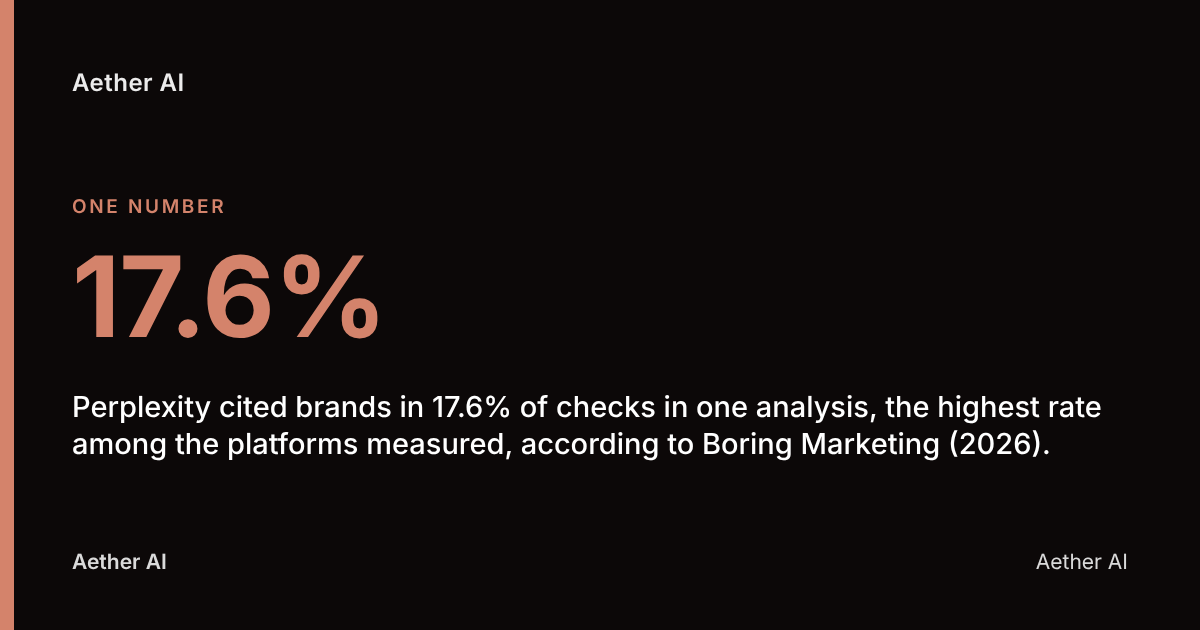
- Perplexity cited brands in 17.6% of checks in one analysis, the highest rate among the platforms measured, according to Boring Marketing (2026).
- A UK professional should treat every Perplexity citation as a prompt to check the original source, its date and its authority before using it in client-facing or regulated work.
What is Perplexity AI and how does it work as an answer engine?
Perplexity AI is an answer engine, a tool that searches the web in real time and returns a synthesised written answer with sources attached, rather than a list of links for the user to click through themselves. It differs from a conventional search engine such as Google Search, which ranks pages and leaves the user to read them.
Perplexity's own documentation describes the product as grounding every response in live retrieval. According to the Perplexity Help Center, "Each answer includes numbered citations linking to the original sources." The company's onboarding material calls Perplexity "the world's first answer engine" with clickable, verifiable citations, as described on the Getting Started with Perplexity page.
Our view: Aether AI's view is that a page answering one question completely and specifically gives an AI assistant something worth citing, while a vague page summarising other pages gives it little reason to credit you. An answer engine like Perplexity is choosing between dozens of candidate pages for each answer it assembles, so specificity is what tends to win a slot.
Perplexity runs on its own retrieval and ranking layer, built on its Sonar infrastructure, documented in the Perplexity Sonar API Documentation. It operates in several modes, including a fast default search and a more exhaustive Pro Search, each pulling a different depth of sources.
How does Perplexity AI select and rank the sources it cites?
Perplexity selects sources by crawling and indexing web content with its own crawler, PerplexityBot, then ranking candidate pages for relevance, freshness and credibility before writing an answer around them. The company states that "All responses are supported by citations from reputable news organizations, academic publications, and established content sources," according to the Perplexity Help Center.
PerplexityBot's own documentation says it is "designed to surface and link websites in search results on Perplexity," per Perplexity's crawler documentation. Publishers can verify genuine crawler traffic against the published PerplexityBot IP ranges, which matters for any UK firm checking its server logs or setting firewall rules.
Perplexity does not publish the exact weighting it gives to domain authority, content freshness or page structure, so the mechanics behind any single citation decision are not fully transparent. What is documented is the outcome: Perplexity cited brands in 17.6% of checks and Gemini in 17.1%, the two highest rates among the AI platforms measured, according to Boring Marketing's AI Visibility Statistics (2026). That is a meaningfully different citation pattern from ChatGPT, which drove 74.78% of AI referral traffic against Perplexity's 7.23% in the same period, per the Kollavo AI Citation Statistics compilation (2026). In other words, Perplexity cites a wider spread of brands even though it sends a smaller share of overall AI referral traffic.
How accurate and reliable are Perplexity's citations compared with other engines?
Perplexity's citations are generally traceable to a live source, which is more transparent than a chatbot that states facts with no link at all. Reliability still varies by the type of source it pulls from, and that variance is measurable.
A 1,237-citation study across ChatGPT, Perplexity, Gemini and Claude found that Perplexity produced 65 of the 75 citations that pointed to Reddit and YouTube, according to the Prefer AI Citation Study (2026). Forum threads and video transcripts are not always vetted or current, so a citation from Perplexity is not automatically equivalent in authority to one from a peer-reviewed journal or a government publication.
Separately, across 680 million AI citations analysed, only 11% of domains were cited by both ChatGPT and Perplexity, according to the Averi / Whitehat SEO study (2026). The low overlap means the two engines are often drawing on different source pools entirely, so cross-checking an answer in both tools will frequently surface different evidence.
Perplexity AI versus Google Search, Bing Copilot and ChatGPT in sourcing
Perplexity, Google Search, Microsoft's Copilot and OpenAI's ChatGPT each handle sourcing differently, and the differences matter for how a business should use them.
| Feature | Perplexity AI | Google Search | Bing Copilot | ChatGPT |
|---|---|---|---|---|
| Output format | Synthesised answer with numbered citations | Ranked list of links | Synthesised answer with citations | Conversational answer, citations when browsing enabled |
| Sources per answer | Average of 20, per Suff Digital (2026) | Not applicable, ranks pages | Varies by query | Varies, fewer than Perplexity |
| Share of AI referral traffic | 7.23% | Not an AI referral channel | Not measured here | 74.78%, per Kollavo (2026) |
| Brand citation rate | 17.6% of checks | Not comparable metric | Not measured here | Lower than Perplexity and Gemini, per Boring Marketing (2026) |
The practical takeaway is that Perplexity cites more widely per answer, while ChatGPT carries far more referral volume overall. A business optimising for AI visibility needs to track both separately, because a presence in one does not guarantee a presence in the other.
What should a UK professional check before trusting a cited source?
A UK professional should verify the publication date, the original author or organisation, and whether the source is primary or secondary before relying on anything Perplexity cites. Perplexity surfaces links; it does not vouch for their editorial standards.
Specific checks worth running:
- Confirm the source is current. Perplexity pulls from the live web, but a cited page can itself be years old or superseded by newer guidance.
- Check whether the source is official. For anything regulatory, prioritise gov.uk, the Information Commissioner's Office, the Health and Safety Executive, or legislation.gov.uk over a commercial blog repeating the same rule.
- Trace forum or video citations back further. Given that Perplexity accounted for 65 of 75 Reddit and YouTube citations in the Prefer AI Citation Study (2026), treat any such citation as a lead.
- Cross-check against a second engine. Because domain overlap between ChatGPT and Perplexity citations is low, per Averi / Whitehat SEO (2026), running the same question through a second tool often surfaces a different, useful source.
For regulated sectors such as financial services overseen by the Financial Conduct Authority or data handling governed by UK GDPR, this verification step is not optional. A citation that looks authoritative in a chat window carries no legal weight on its own.
Can UK businesses use Perplexity's citation format for professional research?
Perplexity's numbered citation format is useful for drafting and internal research, but it does not replace a proper academic or legal citation style such as Harvard, OSCOLA or APA. The numbers link to a URL, not to a formatted reference with author, publisher and access date in the structure most UK institutions and courts expect.
A business preparing a report for a regulator, a tender, or an academic submission should extract the underlying source from Perplexity's citation and reformat it properly. Treat Perplexity as a research accelerator that points you to primary material faster, not as a citation manager in itself.
Your Perplexity AI citation checklist
- Open every citation Perplexity provides and read the original page before quoting it.
- Check the publication date on the source, in addition to the date of your Perplexity query.
- Prefer official bodies such as the ICO, HSE or gov.uk over blogs repeating the same claim.
- Trace Reddit, forum or YouTube citations back to a primary source before using them professionally.
- Run sensitive or regulated queries through a second engine to compare the source pool.
- Reformat any citation used in a formal document into your required academic or legal style.
- Keep a record of the source URL and access date for anything used in client-facing work.
FAQ
Does Perplexity AI always provide citations, even on the free plan?
Yes, Perplexity's standard answer format includes numbered citations on both free and paid tiers, since citing sources is core to how the answer engine presents responses and is not a feature locked to a subscription.
Does PerplexityBot respect robots.txt?
Perplexity publishes crawler documentation and IP ranges for publishers to verify and manage its bots, detailed in the Perplexity Crawlers Documentation. Publishers wanting to block or allow specific crawler behaviour should consult that documentation directly, since crawler behaviour can differ between PerplexityBot and the user-triggered Perplexity-User agent.
Are there copyright considerations in the UK around AI-generated citations?
Yes. UK copyright law, including the Copyright, Designs and Patents Act 1988, still governs the underlying content Perplexity cites, so quoting or reproducing cited material beyond a citation link can raise copyright questions. A business should treat a Perplexity citation as a pointer to the source, then apply normal UK copyright and fair dealing rules to anything it reproduces from that source.
Who is responsible for fact-checking if Perplexity cites an incorrect source?
The user remains responsible for verifying any fact before relying on it professionally, since Perplexity presents citations as supporting evidence and not a guarantee of accuracy. If a cited source is wrong, outdated or taken out of context, that error carries into any decision or document built on it unless it was checked first.
How Aether AI helps businesses understand their Perplexity citations
Getting cited by Perplexity is not the same problem as getting ranked by Google, and a business that only tracks Google Search Console is missing most of the picture. Aether AI tracks citations across six AI engines, including Perplexity, ChatGPT, Google AI Overviews, Claude, Gemini and Copilot, so a business can see which of its pages are actually being pulled into AI answers and which are being ignored.
Aether AI's own measured baseline shows how rare these citations still are: across 700 live AI engine scans of UK brands' target keywords run in July and August 2026, those brands were named in only 23 answers, a 3.3% rate, with the longest-established brand reaching 6.3% across its 270 scans. Tracking prompts forces you to confront the real question set in your market, and most brands discover the questions they answer well are not the ones being asked."
Run a free AI-visibility audit at Aether AI's audit tool to see where your content currently stands across Perplexity and the other major AI engines, and check current pricing to find the plan that fits.