Last updated: 20 November 2026
ROI from GEO (Generative Engine Optimisation, the practice of optimising content to be cited inside AI-generated answers) is measured through citation tracking, branded search lift and AI-referred conversions rather than rankings alone. Industry benchmarks put early-stage returns at 50 to 150% by months three to four, rising sharply as programmes mature, according to ABM Agency's 2025 Guide to Measuring B2B GEO ROI.
Key Takeaways
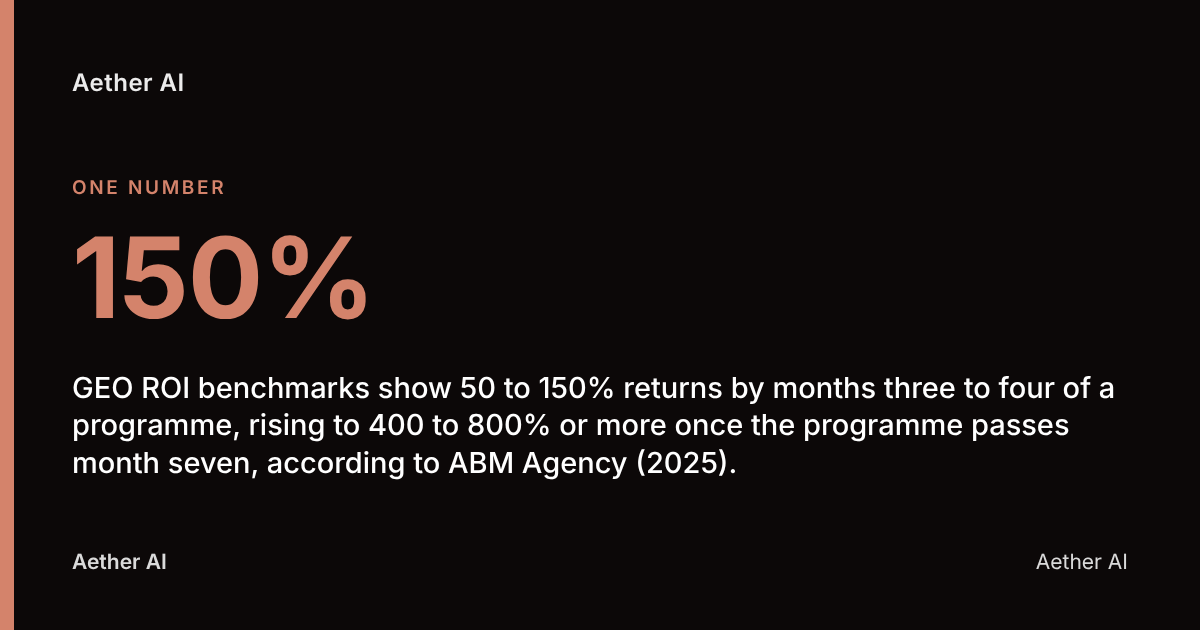
- GEO ROI benchmarks show 50 to 150% returns by months three to four of a programme, rising to 400 to 800% or more once the programme passes month seven, according to ABM Agency (2025).
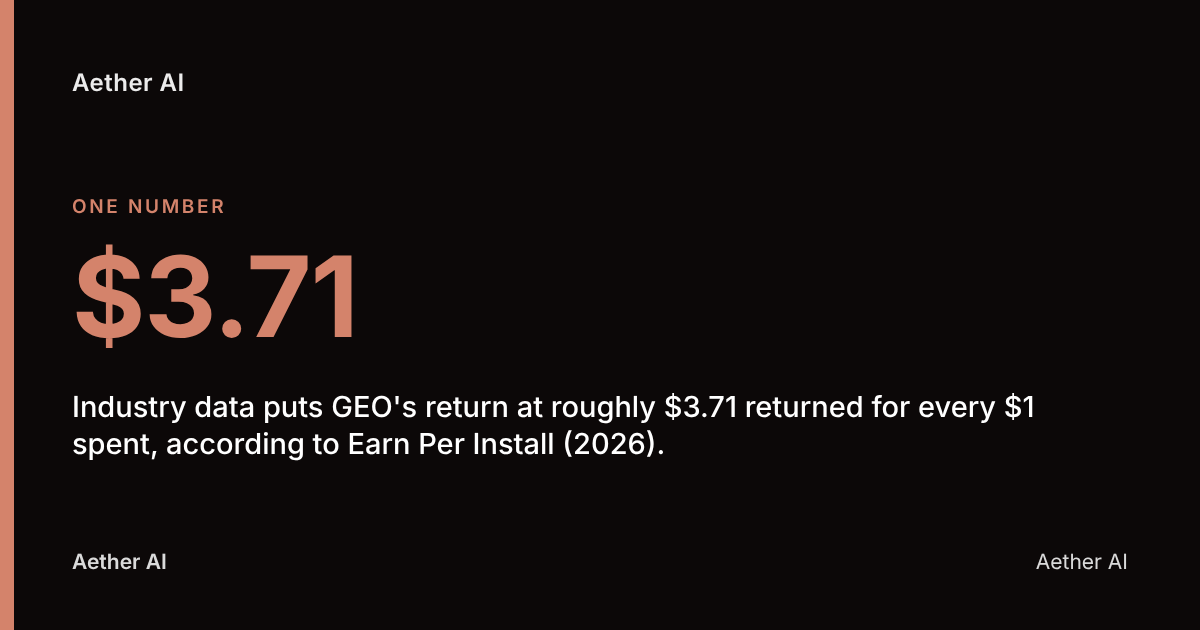
- Industry data puts GEO's return at roughly $3.71 returned for every $1 spent, according to Earn Per Install (2026).
- Adding citations, quotations and statistics to content can lift source visibility in AI answers by over 40% across queries, per the Princeton-led GEO: Generative Engine Optimization study (KDD 2024).
- 93% of CMOs report measurable returns from generative AI investments, according to Squid Impact, cited in Incremys (2025).
- Aether AI's measured baseline across 700 live AI engine scans of UK brands' target keywords (July to August 2026) found those brands named in 23 answers, a 3.3% citation rate, published at aether-ai.co.uk/insights/ai-visibility-baseline-2026.
What Is GEO and How Does It Differ From SEO?
GEO (Generative Engine Optimisation) is the practice of structuring content so AI systems such as ChatGPT, Perplexity, Google AI Overviews, Claude, Gemini and Microsoft Copilot cite it directly in generated answers. Traditional SEO optimises for ranking position on a search results page, built around keywords, backlinks and Core Web Vitals under Google's algorithm.
GEO optimises for something different: inclusion as a cited source inside a synthesised answer, where there is often no click at all. A page can rank nowhere on Google's first page yet still be the sentence an AI engine quotes verbatim to answer a user's question.
The distinction matters for ROI because the two disciplines produce different evidence trails. SEO leaves rankings and organic sessions in Google Search Console. GEO leaves citation counts, share-of-voice across engines, and a harder-to-trace influence on branded search and direct traffic, since many AI answers never pass a referrer at all.
The Princeton, Georgia Tech, Allen Institute for AI and IIT Delhi KDD 2024 paper that coined the term GEO tested nine content optimisation strategies across 10,000 queries. It found that adding citations, quotations from relevant sources, and statistics can boost source visibility by over 40% across various queries, marking the first peer-reviewed evidence that specific content changes move citation likelihood and not only rankings.
How Can a Business Measure ROI From GEO Activities?
Measuring ROI from GEO starts with isolating AI-referred sessions in analytics, then tracking what those visitors do against cost of the programme. The formula is simple in principle: (value generated from AI-sourced visibility minus programme cost) divided by programme cost, expressed as a percentage.
Three data points carry the weight:
- Citation tracking: how often a brand's content is named or quoted across the six major engines, tracked over time against competitors.
- AI-referred traffic quality: conversion rate and signup rate from the (often small) segment of sessions with an identifiable AI referrer.
- Branded search and direct traffic lift: the hardest to attribute cleanly, since most AI answers are zero-click and never register as a referral at all.
The third point explains why so many GEO ROI reports lean on indirect proxies. Ahrefs' own data, reported by Snoika, found AI search sent just 0.5% of its traffic but produced 12.1% of signups over a 30-day window, a signal that AI-referred visitors convert disproportionately well even when their volume looks small on a dashboard. Any ROI calculation that only counts sessions, and ignores conversion quality, will understate GEO's actual return.
Search Console has a separate limit. Across two of the founding team's own properties, Priority First and Aether Agency, between 19 July and 15 August 2026, 82.1% and 88.3% respectively of Google Search Console clicks came from queries Google does not name. Aether AI is built and operated by Aether Agency Ltd. Priority First, Pulse Operations and Aether Agency are businesses connected to the founding team. Google leaves rare and low-volume queries out of its reports to protect searchers' privacy.
What Metrics Indicate GEO Success Beyond Rankings?
Citation share is the primary KPI for GEO, measuring how often a brand appears as a named or quoted source across AI engines relative to competitors. It replaces keyword rank as the headline metric because AI answers rarely expose a ranked list at all.
Useful supporting metrics include:
- Share of AI voice: the proportion of relevant answer sessions where a brand is mentioned, tracked engine by engine (ChatGPT, Perplexity, Google AI Overviews, Claude, Gemini, Copilot).
- Branded search lift: an increase in direct searches for the brand name following a citation surge, a proxy for AI-driven awareness that doesn't always leave a clickable trail.
- Signup or lead quality from AI referrers: using the Ahrefs pattern above as a benchmark, where AI traffic volume is low but conversion is high.
- Query coverage: the breadth of commercially relevant questions where the brand appears at all, versus zero presence.
93% of CMOs report measurable returns from generative AI investments, and 83% of marketing teams see a measurable ROI, according to Squid Impact, cited in Incremys (2025). Separately, companies using AI in their marketing report an ROI that is 22% higher than the average, per the same source. Nearly 70% of businesses using AI tools in their SEO workflows report higher ROI than traditional approaches, according to Envive's 2026 GEO statistics roundup.
How Does ROI From GEO Compare to SEO or Paid Search?
GEO ROI compounds over a longer horizon than paid search but can mature faster than organic SEO's typical twelve-month curve. Paid search delivers immediate, easily attributed ROI tied directly to spend, but returns stop the moment the budget does.
Traditional SEO builds compounding organic value but commonly takes six to twelve months to show meaningful ranking movement on competitive terms. GEO benchmarks suggest a faster early curve: 50 to 150% ROI by months three to four, climbing to 400 to 800% or more past month seven, according to ABM Agency (2025).
| Channel | Typical time to measurable ROI | Attribution clarity | Return profile |
|---|---|---|---|
| Paid search | Immediate | High (direct click tracking) | Stops when spend stops |
| Traditional SEO | 6 to 12 months | High (rankings, GSC data) | Compounds slowly, long-lived |
| GEO | 3 to 4 months (early signal), 7+ months (mature) | Lower (zero-click answers) | Compounds fast once citations stick |
Industry data puts GEO's overall return at roughly $3.71 for every $1 spent, according to Earn Per Install (2026). The same source found programmatic portals built specifically for AI search convert around 18% of visitors, against roughly 0.5% for traditional blog content, a difference of more than thirty times. That gap suggests content format, alongside citation frequency, drives a meaningful share of GEO's return.
What Mistakes Do Businesses Make Calculating GEO ROI?
The most damaging mistake is double-counting revenue that both SEO and GEO content touches, since the two programmes frequently share the same pages and overlap in attribution. A business that credits an entire conversion to GEO when the page also ranks organically on Google will overstate its return.
Other recurring errors:
- Ignoring zero-click answers entirely. Treating "no referrer" as "no value" misses the branded search lift that often follows a citation surge.
- Measuring too early. Citation frequency and branded search lift both take months to build. A one-month snapshot will look flat even in a healthy programme.
- Tracking only one engine. ChatGPT, Perplexity, Google AI Overviews, Claude, Gemini and Copilot each surface different sources for the same query. Single-engine tracking misses most of the picture.
- Assuming competitive saturation won't erode returns. As more brands in a sector adopt identical GEO tactics, the individual payoff from any one tactic can fall, a dynamic rarely addressed in vendor ROI reports.
- Treating vendor case studies as independently audited. Many published GEO ROI figures, including figures in this article, originate from agency or vendor research rather than third-party financial audits. Read benchmarks as directional, not definitive.
Who Should Own GEO Performance Reporting?
Responsibility for GEO sits most naturally with whoever already owns organic search performance, typically an in-house marketing lead or SEO manager, because the skill set (content structure, technical SEO, analytics) overlaps directly. In smaller UK businesses, this is often the founder or a single marketing hire wearing several hats.
Larger organisations increasingly assign GEO reporting to a CMO-level owner, given that 93% of CMOs already report measurable returns from generative AI investment, per Squid Impact's data cited in Incremys (2025). Whoever holds the brief needs visibility across citation tracking tools, Google Search Console and whatever CRM holds conversion data, since GEO ROI only becomes legible when those three data sets are read together.
What Content Changes Improve AI Citation Likelihood?
Structured, citation-rich content is the single most reliable lever for improving AI citation likelihood, based on controlled testing instead of anecdote. The KDD 2024 study found that adding citations, quotations from relevant sources, and statistics lifted source visibility by over 40% across the queries tested, a controlled result from the same Princeton-led research referenced above.
Practical changes that follow from that finding:
- Open each section with a direct, self-contained answer an engine can quote without needing surrounding context.
- Use clear H2/H3 hierarchy so retrieval systems can identify where a passage starts and ends.
- Cite named, checkable sources (regulators, standards bodies, peer-reviewed research) instead of vague claims.
- Include specific figures, dates and named entities instead of generalisations.
- Keep sentences short enough that a single sentence still makes sense lifted out of context.
Tools for Tracking AI Citation and Visibility
Citation tracking tools monitor how often a brand is named across AI engines and compare that share against named competitors over time. This is the category Aether AI operates in: a self-service GEO platform with citation tracking across six AI engines (ChatGPT, Perplexity, Google AI Overviews, Claude, Gemini and Copilot), alongside keyword and competitor tracking and Google Search Console integration.
Businesses evaluating tools in this space should check for three capabilities at minimum: multi-engine coverage (more than one chatbot), historical trend data so citation share can be charted over months, and integration with existing analytics so AI visibility sits alongside organic performance data instead of apart from it.
Your GEO ROI Measurement Checklist
- Define what counts as "GEO-attributed" before the programme starts, and keep that definition consistent.
- Set up citation tracking across all six major AI engines, and not only one.
- Connect Google Search Console data to spot the gap between named and unnamed queries.
- Benchmark branded search volume before launch to measure lift later.
- Review citation share and conversion quality monthly, and not only session counts.
- Wait at least three to four months before judging early ROI, per published benchmarks.
- Flag any revenue also touched by organic SEO to avoid double-counting.
- Re-audit content quarterly for citation-rich structure: sources, quotes, statistics, clear headings.
FAQ
How much does a GEO strategy typically cost for a UK business?
Costs vary widely depending on whether a business builds in-house capability, uses a self-service platform, or hires an agency. There's no single verified UK cost benchmark in current research, but self-service tools (like Aether AI, with pricing published at aether-ai.co.uk/pricing) typically represent the lower end of spend compared with a full-service agency retainer.
Are there UK-specific legal considerations for optimising content for AI search engines?
Yes. Content cited by AI engines must still comply with UK advertising and consumer protection law, including rules enforced by the Advertising Standards Authority and the Consumer Protection from Unfair Trading Regulations 2008, since a misleading claim doesn't become acceptable just because an AI engine repeats it. Aether AI states that data used in GEO content, including any customer statistics, must also comply with the Data Protection Act 2018 and ICO guidance where personal data is involved.
Are there published case studies with real GEO ROI figures?
A handful of agency and vendor figures exist, including the 50 to 150% to 400 to 800%+ benchmark range from ABM Agency and the $3.71-per-$1 figure from Earn Per Install. Most published figures come from agency or vendor research instead of independently audited financial studies, so treat them as directional benchmarks instead of guarantees.
How long before a GEO programme shows measurable returns?
Published benchmarks suggest an early signal within three to four months, with returns accelerating substantially past month seven as citation share compounds, according to ABM Agency's 2025 ROI guide. Single-month snapshots are too early to judge a programme either way.
Proving GEO ROI Starts With Knowing What's Being Cited
Calculating ROI from GEO is only possible once a business can see, engine by engine, where it's being cited and where it's invisible. That's the gap Aether AI closes: citation tracking across ChatGPT, Perplexity, Google AI Overviews, Claude, Gemini and Copilot, paired with automated AI-optimised article generation, keyword and competitor tracking, and Google Search Console integration, all built so a business can connect citation share to the traffic and conversion data it already trusts.
Aether AI's own measured baseline shows exactly why this matters: across 700 live AI engine scans of UK brands' target keywords in July and August 2026, those brands were named in just 23 answers, a 3.3% citation rate overall, though the longest-established brand in the set (a security services business) reached 6.3% across 270 scans. That spread between brands shows citation share is earnable, not fixed, published in full at aether-ai.co.uk/insights/ai-visibility-baseline-2026.
Businesses wanting a starting figure for their own visibility can run a free AI-visibility audit at aether-ai.co.uk/audit, or review pricing directly at aether-ai.co.uk/pricing before deciding where GEO fits in next year's marketing budget.