Last updated: 22 November 2026
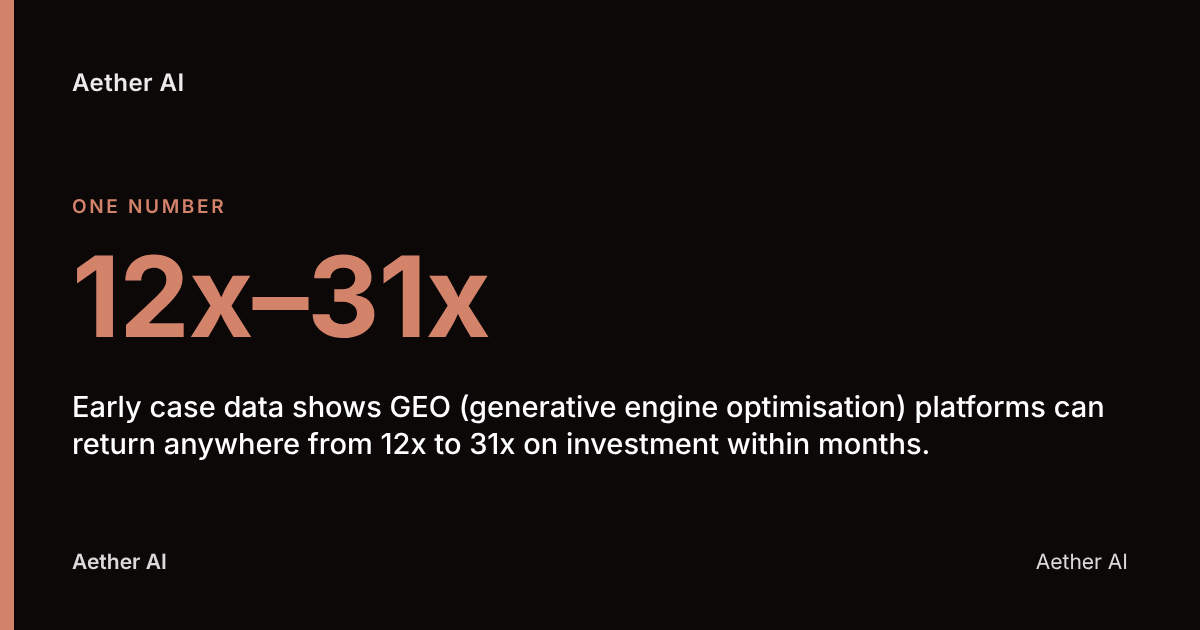
Early case data shows GEO (generative engine optimisation) platforms can return anywhere from 12x to 31x on investment within months. A Series A cloud security startup achieved a strong multiple on its GEO investment, while a pre-IPO SIEM platform achieved a lower but still substantial return on a larger investment. The real figure for your business depends on your starting visibility and how you track the cost.
Key Takeaways
- Early case studies show GEO ROI figures come from specific cybersecurity firms, not a general average, according to GrackerAI (2025).
- AI-referred traffic converts several times higher than traditional organic search traffic, which is the main driver behind the ROI figures.
- Any ROI calculation should start from a measured baseline of how often your brand is already named by AI engines. Do not assume zero.
What a GEO platform does differently from traditional SEO tools
A GEO platform monitors and tries to improve how AI engines name and cite a brand when answering a question. These include ChatGPT, Google AI Overviews, Claude, Gemini and Microsoft Copilot. Traditional SEO (search engine optimisation) tools are built around a different mechanic. They aim to get a page to rank among a list of blue links on a results page a person scrolls through.
GEO works against a different output entirely. An AI assistant reads across many sources, synthesises an answer, and either names your brand within it or does not. There is no page position to track, only a yes or no on citation, and a record of which sources the engine drew from to decide. Wikipedia describes GEO as a distinct discipline from SEO for this reason, with vendors including Adobe, Semrush and Sitecore now building tools for it.
That difference changes what you should measure. A page can rank well in Google and still never be the source an AI assistant quotes. The assistant quotes a sentence; it does not display a page.
Measurable benefits a GEO platform should produce
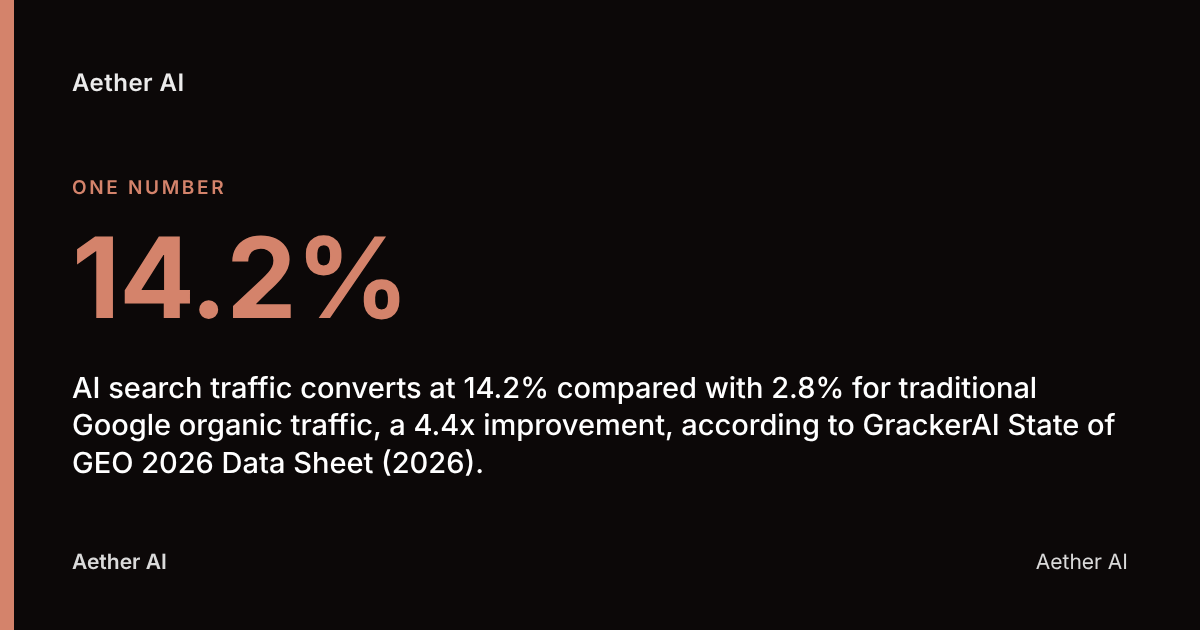
The realistic benefit of a GEO platform is traffic that converts at a higher rate and leads you can trace back to an AI citation. A visibility score climbing on a dashboard is not the same thing. Two figures from separate sources point the same way. AI search traffic converts at 14.2% compared with 2.8% for traditional Google organic traffic, a 4.4x improvement, according to GrackerAI State of GEO 2026 Data Sheet (2026).
A cybersecurity case study compendium found 20 to 35% increases in inbound leads attributable to AI search visibility improvements, and 3 to 5x higher conversion rates from AI-referred traffic against traditional organic search, according to GrackerAI (2025).
Before you can claim any of that uplift, you need to know your starting point. Aether AI's measured AI-visibility baseline, published at aether-ai.co.uk/insights/ai-visibility-baseline-2026, ran 700 live AI engine scans of UK brands' target keywords in July and August 2026. The brands were named in 23 answers, or 3.3%, and the longest-established brand, in security services, was named in 6.3% of its 270 scans. That low starting rate is consistent with how much ground a GEO programme usually has to make up before any lead or conversion figure becomes visible.
How to calculate ROI for a GEO platform
Calculating ROI for a GEO platform means combining three numbers into one formula: your baseline citation rate, your full cost, and the value of an AI-referred lead. Without a starting measurement, any later improvement is unprovable.
- Measure your baseline citation rate. Run a set of the real questions your buyers ask through the AI engines they use, and record how often your brand is named. This is the "before" figure most businesses skip, and without it you cannot claim an increase later.
- Total the full cost, including more than the platform fee. Add the subscription or retainer to the staff or agency time spent on content, monitoring and reporting, as the ABM Agency framework for B2B GEO ROI recommends.
- Assign a conversion value per AI-referred lead. Use your existing sales data to put a pound value on a lead once you can tag it as AI-referred, rather than lumping it in with generic organic traffic.
- Re-run the baseline scan on a fixed schedule. Compare the citation rate and lead volume against your starting figures, and divide the net gain in value by total cost to get your ROI.
WebFX (2025) frames GEO ROI the same way: a return calculated against a defined cost base.
Our view: Aether AI believes the better practice is to measure the answer, not the ranking. Ask the AI assistants your buyers' real questions on a schedule and record who gets named. Rankings on a dashboard do not tell you whether a buyer asking a real question actually heard your brand's name back. A repeated, scheduled check against real buyer questions is the only input the formula above can actually use.
GEO platform vs continuing with traditional SEO or paid search
A GEO platform is not a replacement for SEO or paid search (PPC, pay-per-click advertising). It is an additional channel, with its own cost structure and a faster-moving set of rankings than either of the other two.
| Channel | What it optimises for | Cost pattern | Growth signal |
|---|---|---|---|
| Traditional SEO | Page rank on a search results page | Ongoing content and technical work, slow-compounding | Stable, changes over months |
| Paid search (PPC) | Ad position for a bid keyword | Pays per click, stops when budget stops | Immediate, disappears when spend stops |
| GEO platform | Being named and cited inside an AI-generated answer | Platform fee plus content and monitoring time | Volatile, can shift with each model update |
Generative AI traffic grew 796% over two years, from January 2024 to December 2025, and converted about 1.2x higher than organic search, based on an analysis of 2.3 billion site sessions, according to WebFX (2025). That growth rate has no equivalent in traditional SEO or PPC over the same period, which is why most GEO budgets sit alongside existing search spend rather than replace it.
"Faster than any channel we've worked in. Engines ship new models monthly and answers reshuffle with them. That volatility frightens brands, but it's the point: the rankings aren't fossilised yet. This is the window where challengers can still take the shelf," said Lauren Dawkins, Head of Content, Aether AI
Pricing for GEO platforms ranges from do-it-yourself tools through to mid-market retainers and enterprise programmes, according to Wheerly. The right tier depends on the size of your content operation and how many engines you need to track; a quote confirms the figure for your situation.
What to ask vendors before signing a GEO platform contract
Before signing a GEO platform contract, demand proof that the tool queries real engines the way your buyers actually search, shows its sources, and can act on what it finds. A dashboard that only reports a declining or static score gives you nothing to act on.
"Ask three things: does it query the engines the way real buyers do, does it show you the sources behind every answer, and can it act on what it finds rather than just chart the decline? Dashboards that only observe are grief counselling with a subscription," said Lauren Dawkins, Head of Content, Aether AI
Also ask how the vendor's figures reconcile with your own Google Search Console (GSC) data. Google withholds rare and low-volume search queries from GSC reports to protect searchers' privacy. On two properties connected to Aether AI's founding team, Priority First and Aether Agency, 82.1% and 88.3% of clicks came from queries Google did not name in its reports. This was measured between 19 July and 15 August 2026. Aether AI is built and operated by Aether Agency Ltd. Priority First, Pulse Operations and Aether Agency are businesses connected to the founding team.
That gap matters for ROI maths. Any GEO ROI calculation is built on data with a large unreported portion, so treat the result as a directional estimate.
FAQ
Who within a business should own GEO platform performance, marketing or SEO?
Ownership usually sits with whoever already owns organic search performance, often a marketing or SEO lead, because the baseline measurement and content work overlap heavily with existing SEO responsibilities. A clear owner matters more than which title holds it, since the ROI formula depends on someone running the baseline scan on a fixed schedule.
What internal staff time is needed to run a GEO platform day to day?
Staff time covers reviewing citation reports, briefing or writing content that answers real buyer questions, and checking the platform's findings against actual leads. The exact hours depend on how many keywords and engines you track, and should be added to the platform fee when you total your full cost.
How long does it take to see ROI after adopting a GEO platform?
There is no single confirmed timescale in the data available. The case studies on record show returns measured in months, but each started from its own baseline and cost base. Running your own baseline scan early lets you measure your own timescale.
Are there UK data protection considerations specific to AI search optimisation tools?
GEO tools that process customer or lead data, including any AI-referred leads you tag for ROI tracking, fall under the UK GDPR and the Data Protection Act 2018. This is enforced by the Information Commissioner's Office. Check how a vendor stores and processes any personal data collected through its monitoring or lead-attribution features before signing.
Where to start measuring your own GEO ROI
ROI for a GEO platform is only ever as reliable as the baseline it is measured against. Aether AI's platform tracks citation across six AI engines: ChatGPT, Perplexity, Google AI Overviews, Claude, Gemini and Copilot. It also offers keyword and competitor tracking and GSC integration, so you can see where your brand stands before you calculate a return. Start with Aether AI's free AI-visibility audit to get your own baseline figure, and get in touch to talk through what a GEO investment would look like for your business.