Last updated: 27 November 2026
An e-commerce AI search engine uses natural language understanding and behavioural data to interpret what a shopper means. It returns relevant products from vague or conversational queries. On Shopify storefronts, AI search shows a notably higher conversion rate than organic search, along with higher average order values.
Key Takeaways
- An e-commerce AI search engine reads for intent, typos and context rather than exact keywords, which is why it recovers sales that keyword search misses.
- Costs and go-live timelines depend on your platform, catalogue size and the provider you choose, so ask for a quote rather than budgeting against a headline figure.
- Processing customer search and behavioural data through a third-party AI tool normally needs a data processing agreement and a documented lawful basis under UK GDPR.
What is an e-commerce AI search engine?
An e-commerce AI search engine is software that reads a shopper's query for meaning, not for exact word matches. It ranks products using signals such as synonyms, past behaviour and stock relevance. A traditional on-site search box looks for the literal string a customer typed. If a shopper searches "warm jacket for dog walks" and no product title contains those words, keyword search often returns nothing useful.
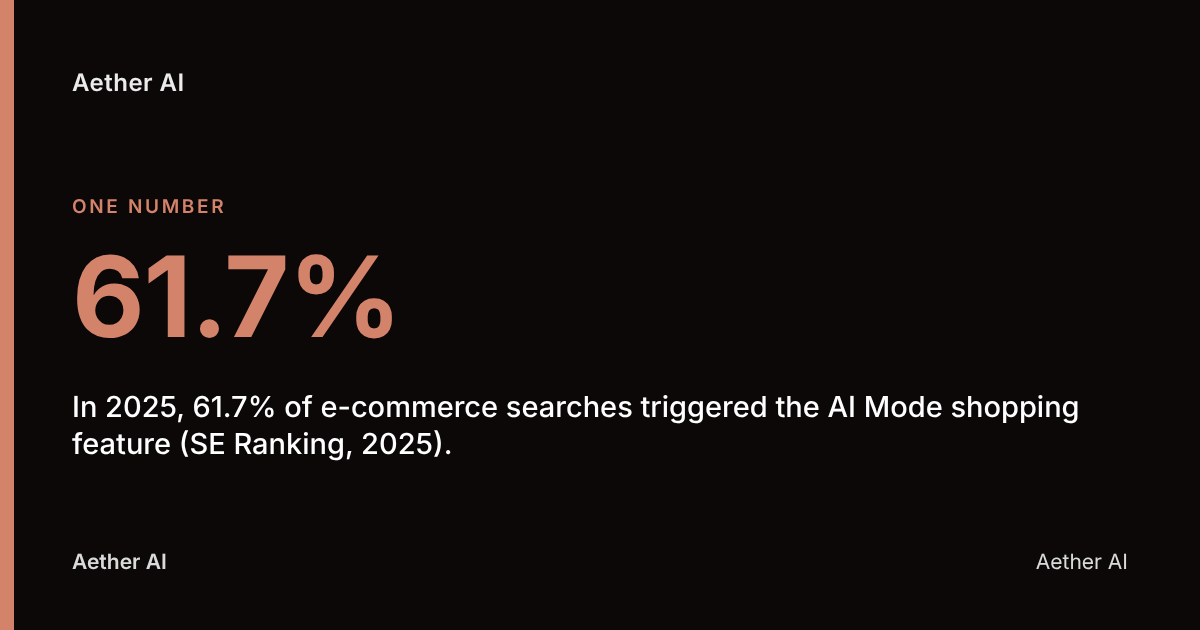
AI search handles that query differently. It recognises intent (outerwear, cold weather, durability), tolerates typos and conversational phrasing, and can rank products a human merchandiser would call sensible even when none of the words match. Shoppers increasingly start their journey inside an AI interface instead of a search box, and that shift grows larger every year. In 2025, 61.7% of e-commerce searches triggered the AI Mode shopping feature (SE Ranking, 2025).
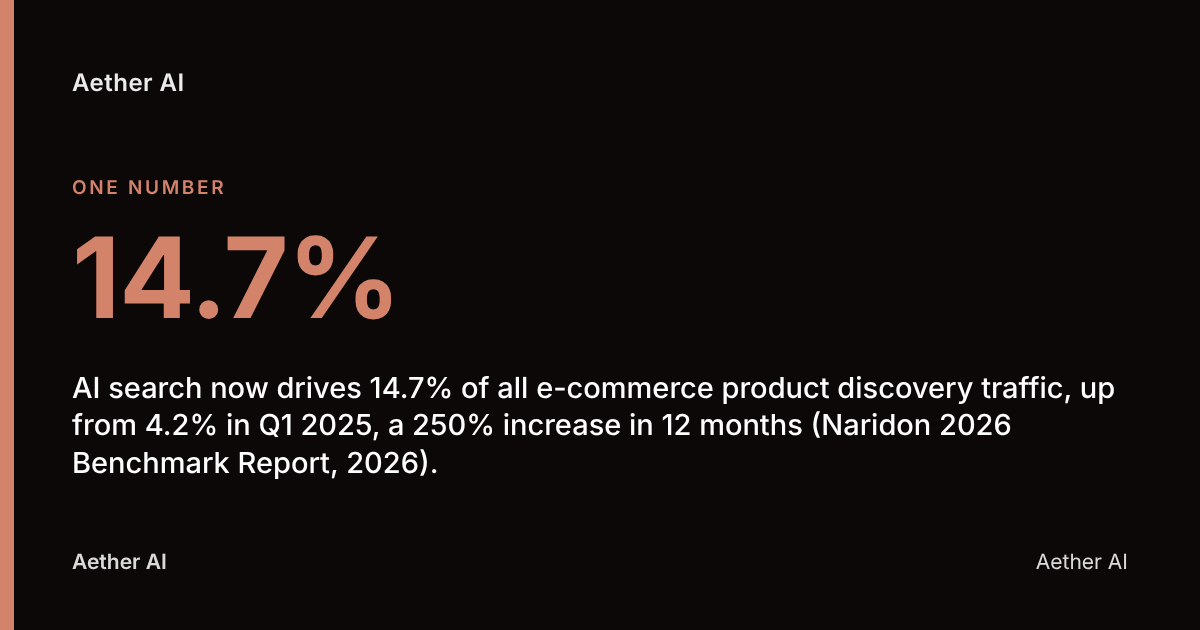
The shift is also visible in where product discovery traffic originates. AI search now drives 14.7% of all e-commerce product discovery traffic, up from 4.2% in Q1 2025, a 250% increase in 12 months (Naridon 2026 Benchmark Report, 2026). For a UK retailer, two separate jobs sit under the same label: improving the search box on your own site, and making sure your products are findable when an external AI engine, such as ChatGPT or Google's AI Overviews, searches on a customer's behalf. Google's own guidance on optimising for generative AI features treats this as a distinct discipline from conventional SEO, with its own content and structure requirements.
Leading AI e-commerce search providers for UK businesses
UK merchants should compare providers on platform compatibility, pricing model and how mature their AI features actually are, looking past brand recognition alone. The table below sets out how the best known options differ in approach.
| Provider | Typical platform fit | Pricing model | Notable strength |
|---|---|---|---|
| Algolia | Shopify, headless, custom builds | Usage-based (API calls, records) | Deep customisation; strong for B2B catalogues |
| Bloomreach | Enterprise and mid-market commerce platforms | Subscription, scaled by catalogue and traffic | Combines search with merchandising and personalisation |
| Constructor | Shopify Plus, enterprise retail | Subscription, often tiered by GMV | Conversion-focused ranking, A/B testing built in |
| Native platform search (e.g. Shopify Search & Discovery) | Shopify stores | Included or low-cost app tier | Fastest to deploy, least customisable |
Algolia's own research into B2B buyers gives useful context on how these tools are actually adopted. The 2025 B2B Ecommerce Site Search Trends Report covers implementation challenges that smaller UK teams often underestimate, including catalogue data quality and internal ownership of search tuning. None of the providers above publish a fixed UK price list that fits every store, because the fee depends on catalogue size, traffic volume and which features you switch on. Treat any figure quoted without a scope attached as a starting estimate, not a firm budget.
Cost, timeline and platform compatibility for UK stores
The real cost of an e-commerce AI search engine covers three things: the setup fee or integration work, the ongoing subscription, and the staff time spent tuning results after launch. A quote from the provider, scoped to your catalogue and platform, is the only reliable way to know what you will pay.
Timelines vary with the same factors. A Shopify store using a pre-built app can often go live within days, because the integration is largely plug-and-play. A headless or custom-built storefront integrating a provider such as Algolia needs development time to map product data, configure ranking rules and test edge cases. This stretches the timeline to weeks. Catalogue size matters too. A retailer with a few hundred SKUs tunes faster than one with tens of thousands, since more product variation means more edge cases to check before launch.
Compatibility is the detail most commonly missed. Before signing, confirm the provider supports your platform natively and can ingest your product feed format without manual reformatting. Also check it offers a sandbox or staging environment so you can test ranking changes before they go live. Skipping the staging step is a common way deployments run over budget, because fixes made in production take longer and risk customer-facing errors.
Because none of the providers compared here publish a single UK price that applies across stores, this article does not state one. If a figure matters to your decision, ask the provider for a quote scoped to your catalogue and traffic, and treat any unscoped number you see elsewhere with caution.
Measurable benefits UK retailers can expect
AI search engines can deliver measurable gains in conversion rate and order value, but the size of that gain depends on your starting point, not the vendor's headline figure. AI-powered customised experiences generally boost revenue by 10 to 15%, with some cases showing improvements up to 25% (Netguru, 2025). That range exists because the uplift depends heavily on how poor the existing search experience was to begin with.
This is why a named baseline, measured before you change anything, matters more than the vendor's benchmark. Aether AI's measured AI-visibility baseline recorded 700 live AI engine scans of UK brands' target keywords in July to August 2026. The brands were named in 23 answers, which is 3.3%. The longest-established brand in that baseline, a security services business, was named in 6.3% of its 270 scans. That pattern, low and uneven visibility even for an established brand, fits the wider shift toward AI-mediated discovery. Being present in the catalogue is not the same as being found by an AI engine.
"Measure the answer, not the ranking. Ask the engines your buyers' real questions, on a schedule, and record who gets named and cited. Everything else, traffic, referrals, enquiries that mention AI, hangs off that one honest time series," said Lauren Dawkins, Head of Content, Aether AI
The practical lesson is to record your own before figure, whatever it is, and not assume a vendor's reported range will transfer directly to your store. A headline uplift reported by one retailer tells you little about what happens to yours if your current search is already reasonably good.
GDPR obligations and common deployment mistakes
Processing UK customer search and behavioural data through a third-party AI search tool is a data processing activity under UK GDPR. This means you need a lawful basis for it and a data processing agreement with the provider. This applies whether the provider stores search queries, click behaviour, purchase history, or all three to personalise results.
Before launch, confirm the provider will sign a data processing agreement that specifies what data it processes, where it is stored, and how long it is retained. Check whether personalisation features use data in ways your existing privacy notice does not yet cover, and update the notice if needed. Document your lawful basis, which for most on-site personalisation is likely to be legitimate interests. Keep that assessment on file in case a customer or the Information Commissioner's Office asks about it.
A costly mistake many firms make is treating AI search as a plug-in-and-forget feature when it needs ongoing fairness checks. Ranking algorithms can quietly favour certain products, brands or price points once trained on real customer behaviour. This can disadvantage smaller suppliers in a marketplace or create pricing bias. Running periodic audits of what the algorithm actually surfaces, beyond whether it converts, catches this before it becomes a customer complaint or a compliance issue.
FAQ
Who in a UK business should manage the AI search engine after launch?
Someone needs clear ownership of search tuning after go-live, usually a digital or ecommerce manager, not IT alone. Tuning decisions, such as which products rank higher and how synonyms are mapped, are commercial judgements.
How does AI search handle multilingual queries, typos and voice search?
AI search engines are built to tolerate variation in how a query is phrased, including typos, synonyms and spoken-style queries from voice search, by matching on meaning. Multilingual support varies by provider, so confirm coverage for any language your customers use before choosing one.
What should be tested before and after launch to check the AI search is accurate and fair?
Test a representative sample of real customer queries, including vague and misspelt ones, before launch to confirm results look sensible to a human reviewer. After launch, periodically check whether certain products, brands or price bands are being systematically under or over-represented in results, beyond whether overall conversion has improved.
How much ongoing staff training does an AI search engine need?
Most platforms need a modest amount of ongoing attention: someone reviewing search analytics periodically, adjusting synonym lists or merchandising rules, and re-testing after major catalogue changes. The time required scales with catalogue size and how often your product range changes.
Getting found, not just installed
Improving your on-site search engine is only half the job. AI search is driving a growing share of product discovery, so your products also need to be findable and accurately described when an external AI engine answers a shopper's question. Aether AI tracks citations across six AI engines (ChatGPT, Perplexity, Google AI Overviews, Claude, Gemini and Copilot), alongside keyword and competitor tracking and GSC integration. This shows whether your store is actually being named in those answers. A free AI-visibility audit shows you where you stand before you commit budget to either side of this problem.