Last updated: 16 November 2026
GEO (Generative Engine Optimisation — optimising content so AI assistants like ChatGPT and Perplexity cite it in answers) differs for B2B versus B2C because B2B buying involves an average committee of 13 stakeholders scrutinising technical proof, while B2C purchases are usually single-person decisions driven by reviews and conversational queries, according to Forrester/Gartner.
Key Takeaways
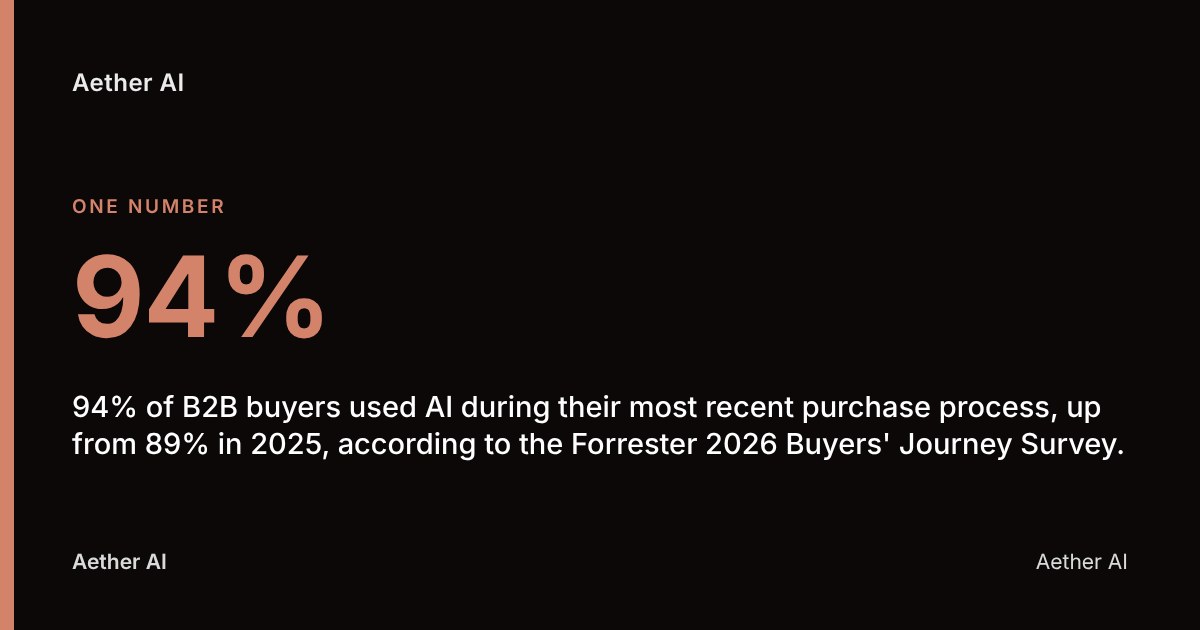
- 94% of B2B buyers used AI during their most recent purchase process, up from 89% in 2025, according to the Forrester 2026 Buyers' Journey Survey.
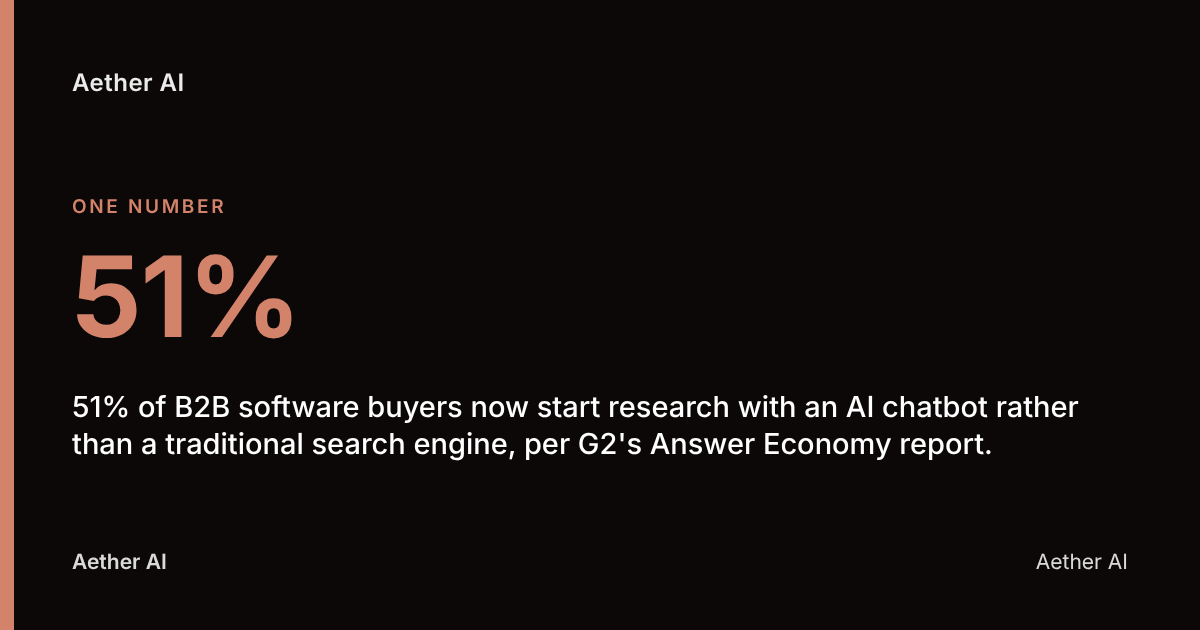
- 51% of B2B software buyers now start research with an AI chatbot rather than a traditional search engine, per G2's Answer Economy report.
- The average B2B buying committee runs to 13 stakeholders, with Gartner putting the range at five to 16 people across up to four functions, according to Forrester/Gartner.
- 63% of marketers say their company invests nothing in GEO despite 67% expecting AI search visibility to matter within two years, found Centerfield's survey of 878 US marketers.
- 58% of users have replaced classic search engines with AI tools when researching products or services, according to Capgemini research.
What Is GEO in the Context of Marketing Strategy?
GEO is the practice of structuring website content, data and authority signals so that generative AI tools — ChatGPT, Perplexity, Google AI Overviews, Claude, Gemini and Microsoft Copilot — select, quote and cite a brand's content when answering a user's question. It sits alongside traditional SEO but optimises for a different outcome: not a blue link and a click, but a cited sentence inside an AI-generated answer.
This distinction matters because the mechanics genuinely differ. Traditional search engines rank pages; generative engines extract and synthesise passages. A page can rank well on Google and still never be quoted by an AI assistant if its facts aren't phrased as clean, standalone claims.
58% of users have replaced classic search engines with AI tools when searching for products or services, according to Capgemini research. Yet 63% of marketers say their company invests nothing in GEO, even though 67% expect AI search visibility to become very or extremely important within two years — and GEO currently receives just 9% of marketing resources against 24% for SEO and 36% for social, per Centerfield's survey. That gap between expectation and investment is precisely where B2B and B2C strategies start to diverge, because the content that wins citations for a software vendor looks nothing like the content that wins citations for a retailer.
How Do B2B and B2C Buyer Journeys Differ in Ways That Affect AI Visibility?
B2B buyer journeys involve multiple stakeholders conducting sequential, evidence-heavy research over weeks or months, whereas B2C journeys are typically a single person making a faster, more emotionally-driven decision — and this shapes which content AI engines surface at each stage.
Forrester's 2026 Buyers' Journey Survey of 18,000 global business buyers found 94% used AI during their most recent purchase process, up from 89% in 2025. Within that, 55% compare vendors in AI tools, 54% research products, and 47% build internal business cases before ever contacting a vendor, according to Forrester. That last figure is the one B2C marketers rarely have to plan for: a B2B buyer may be fully convinced before a salesperson hears from them.
73% of B2B buyers now use AI tools like ChatGPT and Perplexity in their research process, based on a multi-source analysis of 680 million citations, 2,961 controlled research sessions and 1.96 million browsing sessions, according to Averi, reported by Metro Atlanta CEO. Separately, 69% of B2B buyers use AI tools daily, with 95% using them at least once a week, and 84% of professionals surveyed use AI tools for work generally, per Semrush.
A B2C journey compresses this into days or minutes: the buyer asks an AI assistant a conversational question ("best running shoes for flat feet"), reads a synthesised answer with embedded reviews, and purchases. There's rarely a business case to build or a procurement sign-off to clear — which is exactly why B2C GEO content needs to answer the full question in one pass, while B2B GEO content needs to support a much longer, more fragmented research trail.
What Content Should B2B Companies Optimise Compared With B2C Companies?
B2B companies should optimise technical documentation, comparison pages and ROI-focused case studies for AI citation, while B2C companies should prioritise product pages, reviews and conversational FAQ content — because the two audiences are asking fundamentally different types of questions.
A B2B buyer researching a software purchase is likely to ask an AI assistant to compare named vendors on specific technical criteria: integration capabilities, security certifications such as ISO 27001, pricing tiers, or implementation timelines. 51% of B2B software buyers now start their research with an AI chatbot rather than a traditional search engine, based on a March 2026 survey of 1,076 B2B software buyers from G2's Answer Economy report. That means comparison tables, specification sheets and detailed documentation carry disproportionate weight — they're the passages an AI engine lifts to answer "how does X compare to Y."
B2C content works differently. A shopper's query is more conversational and more likely to be answered with aggregated review sentiment, star ratings and simple product attributes rather than a spec-by-spec breakdown. Schema markup choices follow the same split (covered in full below), but broadly: B2B content should read like it was written for a procurement committee doing due diligence, and B2C content should read like it was written to settle a quick decision.
| Content type | B2B priority | B2C priority |
|---|---|---|
| Technical documentation / spec sheets | High | Low |
| Case studies & whitepapers | High | Low |
| Comparison pages (vendor vs vendor) | High | Medium |
| Product pages with structured attributes | Medium | High |
| Customer reviews & ratings | Medium | High |
| Conversational FAQ content | Medium | High |
| ROI calculators / business case content | High | Low |
What Role Do Case Studies and Whitepapers Play in B2B GEO Compared With Reviews in B2C GEO?
Case studies and whitepapers function as the primary trust signal in B2B GEO, giving AI engines a named, sourced example to cite when answering "does this work," while star ratings and user-generated reviews perform the same job for B2C GEO at a much larger volume. Content optimised for generative engines saw visibility increases of up to 40%, with the top techniques being citing credible sources, adding relevant statistics, and including expert quotations, per the Princeton University / Georgia Tech / IIT Delhi study presented at the ACM SIGKDD Conference.
That finding applies to both audiences, but the proof format differs sharply:
- B2B: a single detailed case study with named client, measurable outcome and specific methodology can be cited repeatedly across dozens of related queries — because the buying committee (five to 16 people, per Gartner) needs evidence they can forward internally.
- B2C: volume matters more than depth — hundreds of reviews with consistent sentiment outweigh one polished testimonial, because AI engines synthesising a product answer are pattern-matching across many data points, not evaluating a single document.
Aether AI's own published baseline illustrates how thin citation evidence can be even for established brands: a measured scan of 700 live AI engine queries against UK brands' target keywords across July–August 2026 found those brands named in only 23 answers — 3.3% — while the longest-established brand, a security services provider, was named in 6.3% of its 270 scans, published at aether-ai.co.uk/insights/ai-visibility-baseline-2026. That baseline is consistent with the wider finding that most marketers under-invest in GEO — it isn't a contradiction of it.
How Should Success and ROI Be Measured Differently for B2B GEO Versus B2C GEO?
B2B GEO success should be measured against pipeline influence and committee reach over a multi-month window, while B2C GEO success is better measured through direct citation-to-purchase tracking over days or weeks, because the two sales cycles move at entirely different speeds.
A B2B deal involving an average of 13 stakeholders, per Forrester, rarely converts from a single AI citation. The realistic measurement model tracks:
- Citation share across technical and comparison queries relevant to the buying committee's research stages.
- Branded query lift following a new case study or whitepaper publication.
- Pipeline-influenced revenue, attributed over a quarter rather than a session.
- Share of voice against named competitors in AI-generated vendor comparisons.
B2C GEO, by contrast, can lean on faster signals — conversion-adjacent traffic from AI referrals, review sentiment trends and short-cycle sales lift. One structural complication affects both: Google Search Console leaves rare and low-volume queries out of its reports to protect searchers' privacy. Across two of the founding team's own properties — Priority First and Aether Agency — Google Search Console data from 19 July to 15 August 2026 showed 82.1% and 88.3% of clicks respectively came from queries Google does not name. Aether AI is built and operated by Aether Agency Ltd; Priority First, Pulse Operations and Aether Agency are businesses connected to the founding team. That unnamed-query share is a measurement problem common to both B2B and B2C GEO.
Who Is Responsible for GEO Strategy Across B2B and B2C Organisations?
GEO ownership in UK B2B firms typically sits with content marketing or demand generation leads working alongside sales enablement, because the content serves a long committee-based cycle that crosses departments. In UK B2C firms, ownership more often sits within a combined SEO/e-commerce function, because the feedback loop between content and conversion is faster and more self-contained.
This isn't a fixed rule — smaller UK businesses frequently have one marketing generalist handling both — but the difference in reporting lines reflects the difference in stakeholders. A B2B GEO strategy has to account for what a finance director researching ROI will ask an AI assistant, distinct from what a technical evaluator asks, distinct again from what a procurement lead asks when building a shortlist. A B2C GEO strategy generally serves one persona: the buyer. That's one reason self-serve platforms that handle citation tracking across six AI engines — ChatGPT, Perplexity, Google AI Overviews, Claude, Gemini and Copilot — in one place save B2B teams from manually checking separate tools for separate stakeholder-facing queries.
What Mistakes Do UK Businesses Make Applying One GEO Approach to Both Audiences?
The most common mistake is treating GEO as a single undifferentiated workstream and publishing the same style of content — generic, broad-appeal articles — regardless of whether the audience is a B2B buying committee or an individual consumer. This flattens exactly the signal that makes content citable: specificity.
A second common error is keyword targeting that doesn't match how each audience actually queries AI tools. B2B queries tend to be niche and technical ("ISO 27001 compliant CRM for financial services under 50 seats"), while B2C queries tend to be broad and conversational ("best budget laptop for students"). A business writing broad content for a niche B2B query — or dense technical copy for a simple consumer query — will be overlooked by the AI engine's retrieval step before it even reaches the generation step.
A third mistake, common among UK SMEs: assuming GEO and SEO are interchangeable, when 9% of marketing resources go to GEO against 24% for SEO and 36% for social, per Centerfield — meaning most businesses are under-resourcing the channel precisely as AI-driven research adoption accelerates.
Your GEO strategy checklist
- Identify whether your primary buyer is a committee (B2B) or an individual (B2C) and map content accordingly.
- Publish at least one detailed, named case study if you sell to B2B buying committees.
- Build review volume and structured product data if you sell direct to consumers.
- Match query targeting to buyer language — technical and niche for B2B, conversational and broad for B2C.
- Track citation share across ChatGPT, Perplexity, Google AI Overviews, Claude, Gemini and Copilot, not just Google rankings.
- Set B2B measurement windows in quarters; set B2C measurement windows in weeks.
- Audit your current AI visibility before allocating further budget.
FAQ
How is B2B GEO different from B2C GEO?
B2B GEO optimises technical, evidence-heavy content for a multi-stakeholder buying committee averaging 13 people, per Forrester/Gartner, while B2C GEO optimises conversational product and review content for faster, single-person decisions.
What metrics matter most for B2B vs B2C in AI search optimisation?
B2B GEO should track citation share, branded query lift and quarter-long pipeline influence, while B2C GEO can track faster signals like AI-referral traffic and review sentiment, because B2C sales cycles resolve in days or weeks rather than months.
Do AI models treat B2B and B2C queries differently?
AI models retrieve different types of content depending on query intent — technical, comparison-led queries pull from documentation and case studies, while conversational product queries pull from reviews and FAQ-style content, reflecting the underlying difference in how B2B and B2C buyers phrase their research.
Can a single website serve both B2B and B2C buyers in AI responses?
Yes, but the content needs clear separation — distinct pages, headings and schema for each audience — because mixing technical B2B detail with consumer-facing copy on the same page confuses both the buyer and the AI engine's retrieval process.
Is GEO more important for B2B or B2C companies?
Both need it, but adoption data suggests B2B urgency is currently higher: 94% of B2B buyers used AI during their most recent purchase, per Forrester, and 51% of B2B software buyers start research with an AI chatbot, per G2.
Do B2B and B2C teams need different tools for generative engine optimisation?
Not necessarily different tools, but different configurations — B2B teams need deeper tracking across technical and comparison queries tied to a longer buying cycle, while B2C teams can prioritise broader keyword volume and faster feedback loops within the same platform.
How many stakeholders are involved in a B2B buying committee compared with a B2C purchase decision?
The average B2B buying committee runs to 13 stakeholders, with Gartner's range spanning five to 16 people across up to four functions, according to Forrester/Gartner, compared with a B2C purchase decision that is typically made by one person.
Seeing where your B2B or B2C content stands with Aether AI
Whichever side of this split your business sits on, the underlying problem is the same one this article has been describing: most UK brands have no visibility into whether AI engines are citing them at all. Aether AI was built to close that gap — tracking citations across ChatGPT, Perplexity, Google AI Overviews, Claude, Gemini and Copilot in one place, alongside keyword and competitor tracking and Google Search Console integration, so B2B and B2C teams can see which queries they're winning and which they're invisible on.
Aether AI's own measured baseline — 700 live AI engine scans of UK brands' target keywords across July–August 2026 — found those brands named in just 3.3% of answers, a figure published in full at aether-ai.co.uk/insights/ai-visibility-baseline-2026. That's the kind of baseline every B2B and B2C team should know about their own content before deciding where to invest.
Run a free AI-visibility audit at /audit to see where your brand currently stands, or review public pricing to find the plan that fits your content volume.