Last updated: 23 November 2026
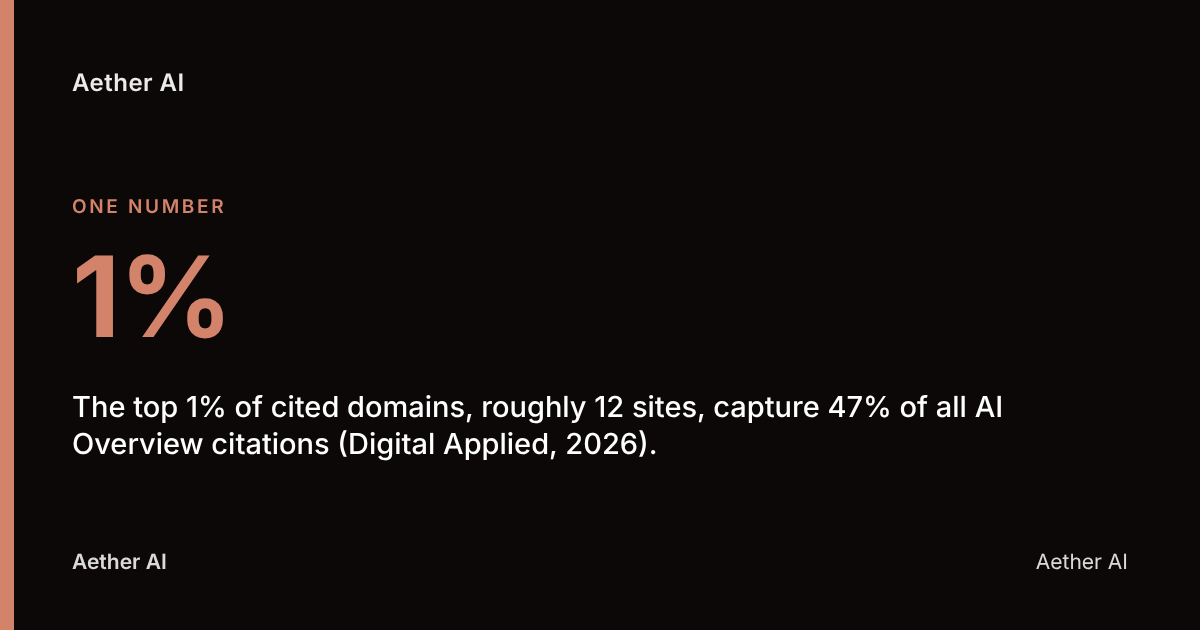
You find top cited sources in AI Overviews by running your target queries through Google and checking the linked sources. You can also use a tracking tool that logs citations at scale. Across the web, a small number of large domains dominate these citations. The top 1% of cited domains, roughly 12 sites, capture 47% of all AI Overview citations (Digital Applied, 2026).
Key Takeaways
- Google's AI Overviews pull most citations from pages already ranking in organic search, so a page with no ranking presence is unlikely to be cited at all.
- A small set of large domains, including Wikipedia, Reddit, Forbes, Healthline and Investopedia, captures a large share of all citations, which means smaller sites do better chasing narrow, specific queries than broad ones.
- Checking citations manually in Google, or with a dedicated tracking tool, only ever shows a snapshot; the same query can return different cited sources hours later.
What AI Overviews are and how Google picks sources to cite
AI Overviews are AI-generated summaries that Google places above the normal list of organic results. They answer a search query directly rather than sending the searcher to a list of links. They are built largely from pages that already rank well for that query, not from content Google has never indexed before.
The link between ranking and citation is strong but not absolute. 38% of AI Overview citations pull from the top 10 organic results (Ahrefs, 2026), which means a majority of citations still come from pages ranking outside that top band. Ranking well helps, but it is not the whole story.
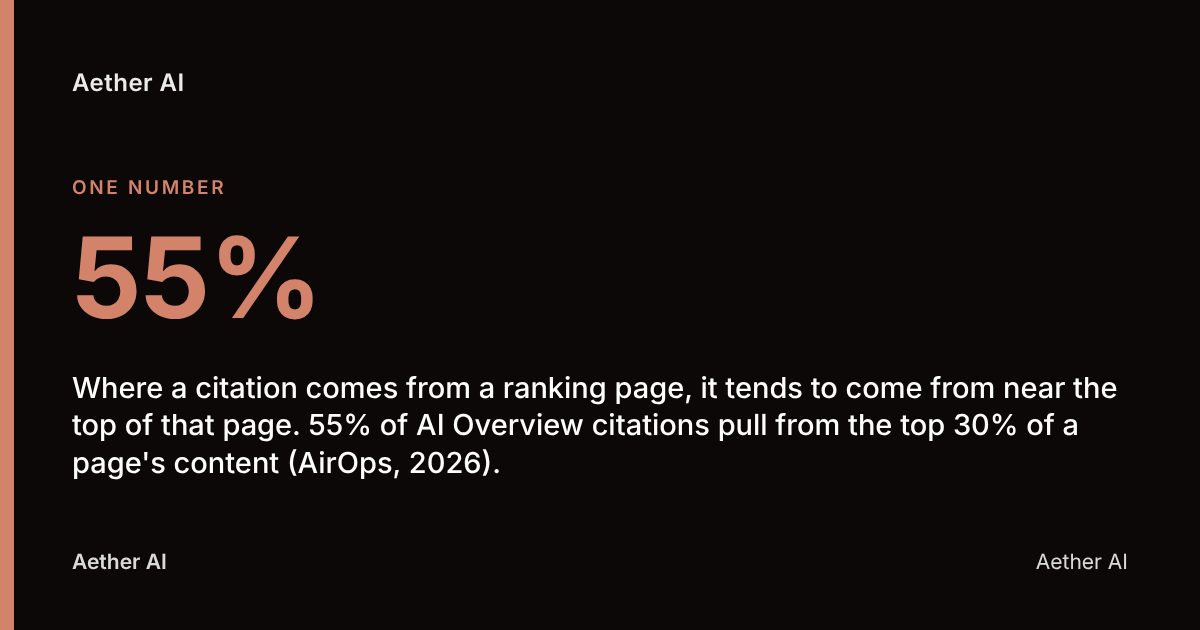
Where a citation comes from a ranking page, it tends to come from near the top of that page. 55% of AI Overview citations pull from the top 30% of a page's content (AirOps, 2026). A direct, early answer to the question a reader asked matters more to citation than length, depth of research, or how far down the page the detail sits.
Our view: Aether AI believes a page that answers one question completely and specifically gives an AI assistant something worth citing. A page that simply summarises what other sites already say gives it little reason to credit you. This fits the citation data: AI Overviews pull from the top of a page, where the query gets answered directly.
How to check which sources are currently cited for a query
You check which sources are cited for a query either by looking manually in Google or by using a tool built for monitoring citations at scale. Both routes are useful, and most businesses end up using a mix of the two.
To check manually:
- Search your target query in Google, using a UK location and a signed-out or private browser window to reduce personalisation.
- Open the AI Overview box if one appears, and expand it fully rather than reading only the summary line.
- Note every linked source shown, since AI Overviews usually cite more than one page.
- Repeat the same query a day or two later, since citations shift, and record whether the same sources appear.
- Repeat across a list of your actual target queries, since citation behaviour varies by query.
Manual checking costs nothing but your time, and it is the quickest way to get a feel for who is being cited in your market today.
For tracking at scale, dedicated tools log citations across many queries automatically, often across several AI engines, and keep a record over time so you can see change. Ahrefs Brand Radar is one example of a commercial dataset built this way. Whether a paid tool is worth it depends on how many queries you need to monitor and how often; for a handful of terms checked occasionally, manual checking is enough.
Why a handful of domains dominate AI Overview citations
A small number of large, high-authority domains dominate AI Overview citations, which matters for how a smaller business should plan its approach to being cited. The top 1% of cited domains, roughly 12 sites, capture 47% of all AI Overview citations (Digital Applied, 2026). These include Wikipedia, Reddit, Forbes, Healthline, Investopedia and larger gov or edu domains.
One domain in particular stands out above the rest. YouTube is the most-cited domain in Google AI Overviews, capturing a 24.5% mention share among the top 50 sources as of November 2026 (Ahrefs, 2026). No single business competes with that kind of domain-wide authority on a broad topic, and trying to is not a realistic goal.
What this means in practice is narrower targeting. A business page is far more likely to be cited for a specific question tied to its own expertise, such as a particular regulation, process or local service. Competing on specificity, not scale, is the more realistic path for most sites.
Mistakes that stop a page being cited, and what to fix instead
One frequent mistake is publishing a page that summarises what other sources already say, without answering a specific question in its own right. AI Overviews are built to answer a question directly, and a page that hedges, generalises or restates existing coverage gives the system nothing distinct to quote.
A second mistake is answering the question too far down the page, after background, history or scene-setting that delays the actual answer. Since citations concentrate near the top of a page's content, an answer that only appears after several paragraphs of lead-in is less likely to be picked up.
A third mistake is writing for a broad topic a large reference domain already dominates, without tying the content to a narrow question drawn from the business's own expertise. Fixing this means choosing specific, answerable questions, putting the direct answer in the opening sentences, and avoiding restating what Wikipedia, Reddit or a major publisher has already covered well.
Tracking your own site's citations over time
Citation tracking works best as an ongoing exercise, because citation rates for any individual brand tend to be low and uneven across queries. A query cited today may not be cited next week, and a query never cited before might start being cited after a page is rewritten.
Aether AI's measured AI-visibility baseline, published at aether-ai.co.uk/insights/ai-visibility-baseline-2026, ran 700 live AI engine scans of UK brands' target keywords between July and August 2026. The brands were named in 23 answers, or 3.3%, and the longest-established brand, in security services, was named in 6.3% of its 270 scans. That pattern, a small, uneven share of queries returning a citation, matches how concentrated citations are more broadly.
The practical lesson is to track a defined set of your own target queries regularly. A single check tells you what happened on that day, for that query, in that location; it does not tell you what will happen next month.
One real limit applies to every method described here: AI Overviews vary by query phrasing, location and time, so no check run today can guarantee a citation tomorrow. Treat any result, yours or a competitor's, as a snapshot.
Your AI Overview citation checklist
- Search your actual target queries in Google with a UK location and note every source the AI Overview links to.
- Expand the AI Overview box fully to see the complete summary, not just the first line.
- Repeat the same queries a few days later to see whether citations hold or change.
- Check whether the cited pages answer the query directly near the top, or bury the answer further down.
- Avoid competing on broad topics already dominated by major reference domains; choose narrow, specific questions instead.
- Set up a recurring check, manual or tool based, in place of a single one-off search.
- Rewrite any underperforming page so it answers one question completely, without simply summarising what other sources say.
FAQ
Is being cited in an AI Overview the same as ranking in normal organic search results?
No. Ranking and citation are related but not identical. A majority of AI Overview citations still come from pages ranking outside the top 10 organic results (Ahrefs, 2026). A page can rank well without being cited, or be cited from a lower ranking position.
Does the UK market affect which sources get cited in AI Overviews?
AI Overviews adjust results by location, so running checks from a UK location, signed out where possible, gives a more accurate picture of what a UK searcher actually sees. The cited data in this article reflects global domain-level patterns.
How often does Google change which sources appear in AI Overviews?
Citations can change between repeated runs of the same query, sometimes within days. This is why a single check is only a snapshot; regular, repeated checking over time gives a far more reliable picture than one search.
Can a small website ever get cited alongside large sites like Wikipedia or Reddit?
Yes, though it is less likely on broad topics those sites already dominate. A small site's best chance is a narrow, specific question tied closely to its own expertise, answered directly near the top of the page.
Finding your own AI Overview citations
Checking who gets cited for your target queries is the easy part. Knowing whether your own pages are ever named, across Google AI Overviews and other AI engines, is harder to keep on top of without a dedicated system. Aether AI offers citation tracking across six AI engines, including ChatGPT, Perplexity, Google AI Overviews, Claude, Gemini and Copilot. It also offers a free AI-visibility audit to show where your pages currently stand. Get in touch to see where your own site is, and is not, being cited.