Last updated: 4 November 2026
LLM SEO vs GEO is largely a naming dispute, not a strategic one: both terms describe optimising content so tools such as ChatGPT, Perplexity and Google AI Overviews cite your business directly in a generated answer. The real distinction that matters is budget — UK marketers currently give GEO just 9% of resources against 24% for SEO, according to a Centerfield survey reported by Search Engine Land (2025).
Key Takeaways
- LLM SEO and GEO (Generative Engine Optimisation) describe the same discipline — optimising for citation inside AI-generated answers rather than for a ranked blue link.
- The generative engine optimisation market was worth an estimated USD 390 million in 2025 and is projected to reach USD 4,250 million by 2032, a 41% CAGR, according to MarketsandMarkets (2025).
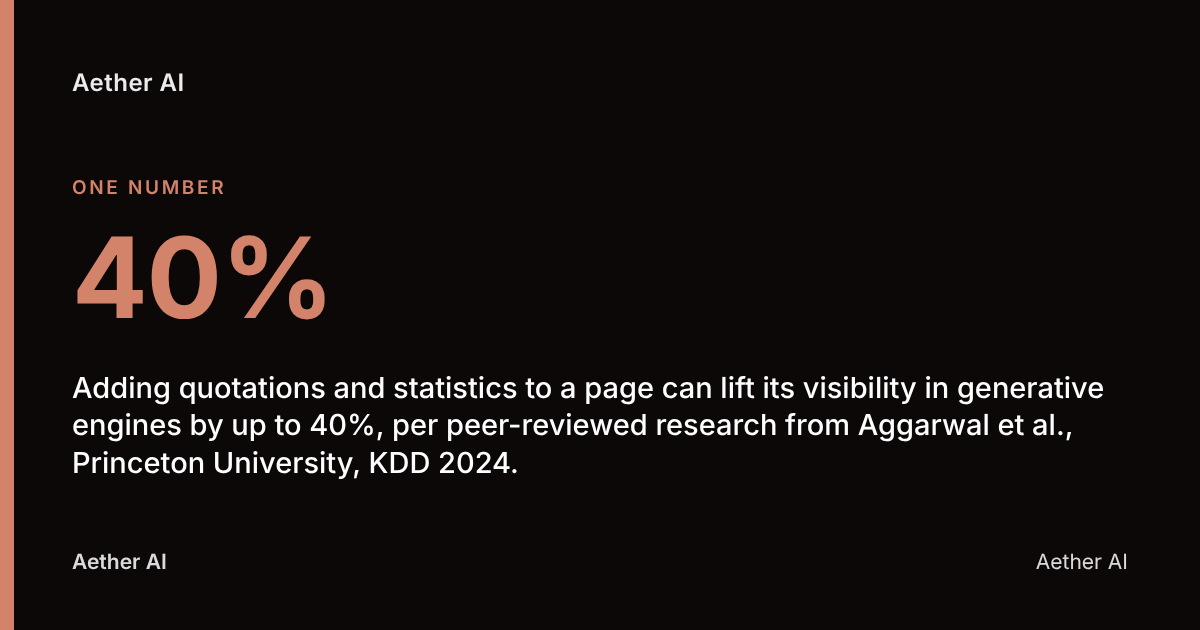
- Adding quotations and statistics to a page can lift its visibility in generative engines by up to 40%, per peer-reviewed research from Aggarwal et al., Princeton University, KDD 2024.
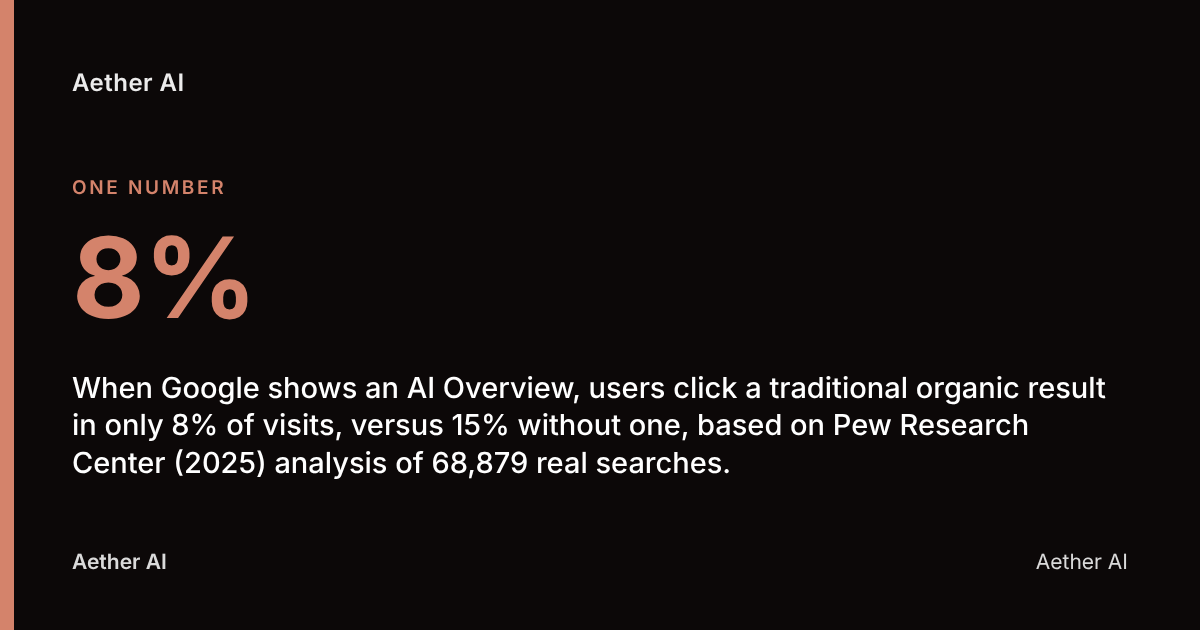
- When Google shows an AI Overview, users click a traditional organic result in only 8% of visits, versus 15% without one, based on Pew Research Center (2025) analysis of 68,879 real searches.
- Only 33% of marketers rate their GEO understanding as good or expert, compared with 72% for SEO, according to Centerfield (2025) — a knowledge gap most UK competitors haven't closed yet.
What is LLM SEO and GEO, and are they the same discipline?
LLM SEO is the practice of structuring website content so large language models — the AI systems, such as GPT-4 or Gemini, that generate human-like text from training data — can understand, retrieve and cite it accurately. GEO, or Generative Engine Optimisation, is the formal academic and industry term for the identical practice, coined in the paper "GEO: Generative Engine Optimization" presented at the ACM SIGKDD Conference in 2024.
Both terms sit alongside AEO (Answer Engine Optimisation), a third label used mostly by marketers who came from the voice-search and featured-snippet world. As one industry commentator put it: "SEO is about optimizing content for visibility in organic search results. With GEO, you're optimizing an entity to show up in a chatbot or AI-generated summary" — Josh, Contentful.
For a UK business professional deciding where to invest, the terminology barely matters. What matters is this: traditional SEO optimises for a ranking position in a list of ten blue links; GEO optimises for a sentence or paragraph being selected, synthesised and attributed inside a generated answer. Aether AI, the GEO platform built by Aether Agency Ltd, treats LLM SEO and GEO as interchangeable in its own product language for exactly this reason — the mechanics of citation are the same whether you call it GEO, LLM SEO or AI visibility.
How does optimising for ChatGPT and AI Overviews differ technically from Google ranking?
Optimising for generative engines means structuring content so a model's retrieval system can extract a single self-contained claim, whereas Google ranking optimisation targets a whole page's relevance and backlink authority for a query. The two processes share some DNA — both reward expertise and clear structure — but they score fundamentally different units of content.
Traditional SEO ranks pages. Google's algorithm evaluates the whole document against hundreds of signals, including backlinks, page speed, Core Web Vitals and topical authority, then returns ten ranked URLs. A searcher chooses which to click.
Generative engines rank passages. An LLM — or Google's own AI Overviews feature, which now appears in an estimated 25–40% of Google searches according to MarketsandMarkets (2025) — retrieves the most extractable sentence or paragraph from several sources, synthesises them, and presents a single answer with (sometimes) a citation. The user never sees your full page. They see one sentence of it, possibly without even clicking through.
This shift has already changed click behaviour. AI-referred web sessions surged over 527% year-over-year in the first half of 2025, while organic click-through rates on pages where AI Overviews appear have fallen by as much as 61%, per MarketsandMarkets (2025). Separately, Pew Research Center (2025) found that users clicked a link inside an AI summary in only about 1% of visits, and 26% of search sessions with an AI summary ended with no further click at all, compared with 16% of sessions without one. Pew's data scientist Athena Chapekis summarised the core finding: "Users who encountered an AI summary clicked on a traditional search result link in 8% of all visits."
| Factor | Traditional Google SEO | LLM SEO / GEO |
|---|---|---|
| Unit ranked | Whole page/URL | Extractable passage or sentence |
| Primary signal | Backlinks, authority, Core Web Vitals | Clear definitions, named entities, citable statistics |
| Visible output | Ten ranked blue links | One synthesised answer, sometimes with citation |
| Click behaviour | User chooses from a list | User reads answer; click-through drops to roughly 8% with a summary present (Pew Research Center, 2025) |
| Measurement | Google Search Console rankings & clicks | Citation tracking across multiple AI engines |
What on-page and content changes should a UK business make to improve AI visibility?
UK businesses improve AI visibility by restructuring existing pages around self-contained, citable facts rather than by writing entirely new content. The academic research behind GEO is specific about which interventions work: adding direct quotations, citing statistics, and including named sources can each measurably increase a page's chance of being selected by a generative engine.
Practical changes that follow from this research include:
- Open every section with a direct, standalone answer. Define the topic in the first sentence rather than building up to it — retrieval systems favour passages that make sense without the paragraph before them.
- Name real entities. Reference specific regulators (the ICO, the ASA, the SIA), legislation (the Data Protection Act 2018), and standards (ISO 27001) rather than vague phrases like "industry rules."
- Add quotations and statistics with attribution. KDD 2024 research found this single intervention can lift generative-engine visibility by up to 40%, per Aggarwal et al. (2024).
- Use clean heading hierarchy — one H1, properly nested H2/H3s — so a model can identify where a passage begins and ends.
- Build comparison tables for any "versus" or "which option" topic; tables are lifted wholesale into generated answers more often than prose.
- Keep paragraphs short and factual, avoiding pronouns like "it" or "this" as the subject of a key sentence, since a model extracting that sentence in isolation needs the subject named.
This is the methodology Aether AI's article-generation engine applies automatically across every brand it publishes for, rather than treating it as a manual checklist a writer might skip.
How should a UK business measure GEO success without Search Console data?
GEO success is measured primarily through citation tracking — monitoring how often, and in what context, a brand is named inside AI-generated answers across multiple engines — because AI assistants don't expose the click and ranking data that Google Search Console provides for traditional search. This is the single biggest operational gap marketers face when they move budget from SEO to GEO.
Where Search Console shows impressions, average position and click-through rate per query, ChatGPT, Perplexity, Gemini and Copilot show none of that by default. A business can ask the same question repeatedly and get different citations each time, because generative answers aren't static rankings — they're generated fresh, often influenced by conversation context, user location and model updates.
The practical measurement framework that's emerged instead has three layers:
- Citation frequency — how often a brand's name, product or domain appears in answers to its target queries, tracked across engines rather than a single one, since ChatGPT, Perplexity and Google AI Overviews can cite entirely different sources for the same question.
- Share of voice against named competitors — not just whether you're cited, but how often relative to the two or three brands most likely to compete for the same answer.
- Referral traffic from AI platforms, segmented in standard web analytics tools, even though the volume will look small against organic search for now given AI-referred sessions are still a fraction of total traffic despite their 527% year-over-year surge in the first half of 2025, per MarketsandMarkets (2025).
Aether AI's citation tracking covers six AI engines — ChatGPT, Perplexity, Google AI Overviews, Claude, Gemini and Copilot — specifically because single-engine tracking misrepresents real visibility; a brand well-cited in Perplexity may be invisible in Gemini. Direct integration with Google Search Console matters more than it first appears: a GEO platform's own measured baseline found that 82.1% of Search Console clicks on Priority First and 88.3% on Aether Agency came from queries Google does not name in its standard reports (19 July–15 August 2026). That hidden-query share is where AI-driven, long-tail search behaviour is already showing up inside existing Search Console data — most businesses just aren't looking for it.
What budget and timeframe should a UK SME expect for GEO versus SEO?
A UK SME should expect GEO to require a smaller absolute budget than an established SEO campaign today, but that gap is closing fast because GEO is still chronically under-resourced relative to its growth trajectory. 63% of marketers say their company isn't investing any time, budget or staff in GEO at all, and where resources are allocated, GEO receives only 9% of the marketing budget against 24% for SEO and 36% for social, according to Centerfield, reported by Search Engine Land (2025).
That imbalance is itself the opportunity. The generative engine optimisation market is forecast to grow at a 41% CAGR between 2026 and 2032, per MarketsandMarkets (2025) — a growth rate most UK SMEs aren't budgeting for because, per Centerfield's same survey, only 33% of marketers rate their GEO understanding as good or expert.
In practical terms, an SME already running SEO can usually extend into GEO with incremental rather than additional spend, because the content work overlaps substantially: restructuring existing pages for citability, adding named sources and statistics, and improving heading hierarchy are changes that help both disciplines simultaneously. A self-serve platform model — where a business runs its own AI-optimised article generation and citation tracking rather than commissioning bespoke agency work for each — is one way SMEs are keeping GEO spend proportionate while the market matures. Expect early citation gains within weeks of structural changes, but meaningful share-of-voice against competitors typically takes a full content cycle of two to three months, mirroring how long organic SEO authority takes to build.
Who should own GEO strategy inside a UK company?
GEO strategy should sit with whoever already owns content and SEO inside a UK business — typically marketing or a dedicated SEO lead — rather than with IT, because the discipline is fundamentally about content structure and claims, not infrastructure. The skill gap is real, though: Centerfield's research shows marketers are far less confident in GEO (33% rate their understanding as good or expert) than in SEO (72%), per Search Engine Land (2025).
That confidence gap is why many UK businesses default to one of three ownership models:
- In-house marketing, upskilled through the overlap with existing SEO knowledge — the fastest route for teams that already understand technical SEO and structured content.
- An external specialist agency, commissioned for strategy and execution where internal capacity or expertise is the constraint.
- A self-serve platform, where the business retains control of publishing cadence and tracking but uses purpose-built software to handle the AI-optimisation mechanics, citation tracking across engines, and Search Console integration without hiring a dedicated GEO specialist.
Whichever model a business chooses, the person or team accountable for GEO needs working knowledge of structured content, basic understanding of how retrieval-augmented generation selects sources, and the discipline to track citations across engines rather than assuming Google performance predicts AI performance.
What mistakes do UK businesses make applying old SEO tactics to AI search?
The most common mistake is treating GEO as a rebadged keyword-density exercise rather than recognising it rewards citable, structured factual claims. Businesses that simply repeat target keywords across a page — a tactic that stopped working for Google years ago — see no improvement in AI citation rates because generative engines are extracting meaning and claims, not matching strings.
Other recurring mistakes include:
- Writing generic, uncited content. A page with no named sources, no statistics and no specific entities gives a retrieval system nothing extractable to cite.
- Burying the answer. Sections that build to a conclusion over several paragraphs get skipped by engines looking for a direct answer in the first two sentences.
- Tracking only Google. A business that checks its position in Google AI Overviews but ignores ChatGPT, Perplexity and Copilot is measuring a fraction of its real AI visibility.
- Assuming backlinks alone will carry GEO the way they carry SEO. Authority still matters, but structural citability — named entities, clear definitions, quoted statistics — is the distinguishing factor the KDD 2024 research identified, lifting visibility by up to 40% per Aggarwal et al. (2024).
- Ignoring the 63% majority problem. Because most marketers (63%, per Centerfield, 2025) aren't investing in GEO at all, businesses that do invest — even modestly — are competing against a largely empty field for now.
Your LLM SEO vs GEO action checklist
- Audit your three highest-traffic pages for extractable, standalone factual sentences.
- Add named regulators, legislation or standards wherever you currently write "industry rules" or "the authorities."
- Insert at least one cited statistic with a linked source into each key page.
- Restructure headings into a clean H1 → H2 → H3 hierarchy with no skipped levels.
- Set up citation tracking across at least three AI engines, not just Google AI Overviews.
- Connect your GEO tracking to Google Search Console to surface hidden long-tail queries.
- Assign clear ownership — marketing, agency or platform — before scaling content output.
- Re-check citation share monthly rather than assuming a one-off content refresh is sufficient.
FAQ
Is GEO the same as LLM SEO?
Yes — LLM SEO and GEO (Generative Engine Optimisation) describe the same underlying discipline: structuring content so AI systems retrieve and cite it. The GEO label originates from the KDD 2024 academic paper that formalised the term, while "LLM SEO" is more commonly used in UK marketing conversations.
Does traditional SEO still matter if I invest in GEO?
Yes, traditional SEO remains essential because Google AI Overviews still draw on indexed, ranked content, and strong domain authority continues to influence whether a model considers a source trustworthy. GEO and SEO overlap substantially rather than competing for the same budget line.
How do I know if AI assistants are already citing my content?
Manually query ChatGPT, Perplexity, Google AI Overviews, Claude, Gemini and Copilot with your target questions and note whether your brand or domain appears, then repeat regularly since answers change over time. Aether AI's free AI-visibility audit at /audit automates this check across all six engines.
What's a realistic budget for a UK SME starting GEO?
Most of the required work — restructuring existing content, adding citable statistics, improving heading hierarchy — overlaps with good SEO practice, so incremental rather than wholly new budget is typical to start. Given 63% of marketers currently invest nothing in GEO (Centerfield, 2025), even a modest, consistent investment puts a business ahead of most competitors.
Can one person run GEO alongside existing SEO responsibilities?
Yes, for most SMEs, because the skills overlap substantially with existing content and SEO work; the main additional requirement is citation tracking across multiple AI engines rather than just Google rankings. Larger organisations with dedicated SEO teams typically fold GEO into that team's remit rather than hiring separately.
Will Google's AI Overviews eventually replace the traditional ten blue links?
AI Overviews already appear in an estimated 25–40% of Google searches, per MarketsandMarkets (2025), and where they appear, click-through to organic results drops sharply. A full replacement of ranked results isn't confirmed, but the direction of travel — more synthesis, fewer clicks — is already measurable.
Which AI engines should a UK business prioritise tracking first?
Prioritise the engines most used by your audience — ChatGPT reached 800 million weekly active users by October 2025 according to MarketsandMarkets (2025), making it a sensible starting point — but track Google AI Overviews, Perplexity, Claude, Gemini and Copilot alongside it, since citation behaviour varies significantly by engine.
Tracking your citations across six AI engines with Aether AI
Everything covered in this article — restructuring content for citability, tracking performance without Search Console data, and deciding where GEO ownership sits — is the day-to-day problem Aether AI was built to solve for self-serve UK businesses. Rather than treating GEO as a manual audit exercise, Aether AI's platform automates AI-optimised article generation alongside citation tracking across ChatGPT, Perplexity, Google AI Overviews, Claude, Gemini and Copilot, so a founder or in-house marketer can see where they're actually being cited, not just where they rank on Google.
As proof of its own method, Aether AI's measured AI-visibility baseline scanned UK brands' target keywords 700 times across AI engines between July and August 2026 and found those brands named in just 3.3% of answers overall — with the longest-established brand, a security services business, named in 6.3% of its 270 scans. Aether AI is built and operated by Aether Agency Ltd. Priority First, Pulse Operations and Aether Agency are businesses connected to the founding team, and the same engine writes and publishes for them, which is why these numbers are published rather than claimed.
If you want to see where your own business currently stands, run the free AI-visibility audit at aether-ai.co.uk/audit, or check public pricing to see how self-serve GEO compares to commissioning bespoke agency work for every content update.