Last updated: 28 November 2026
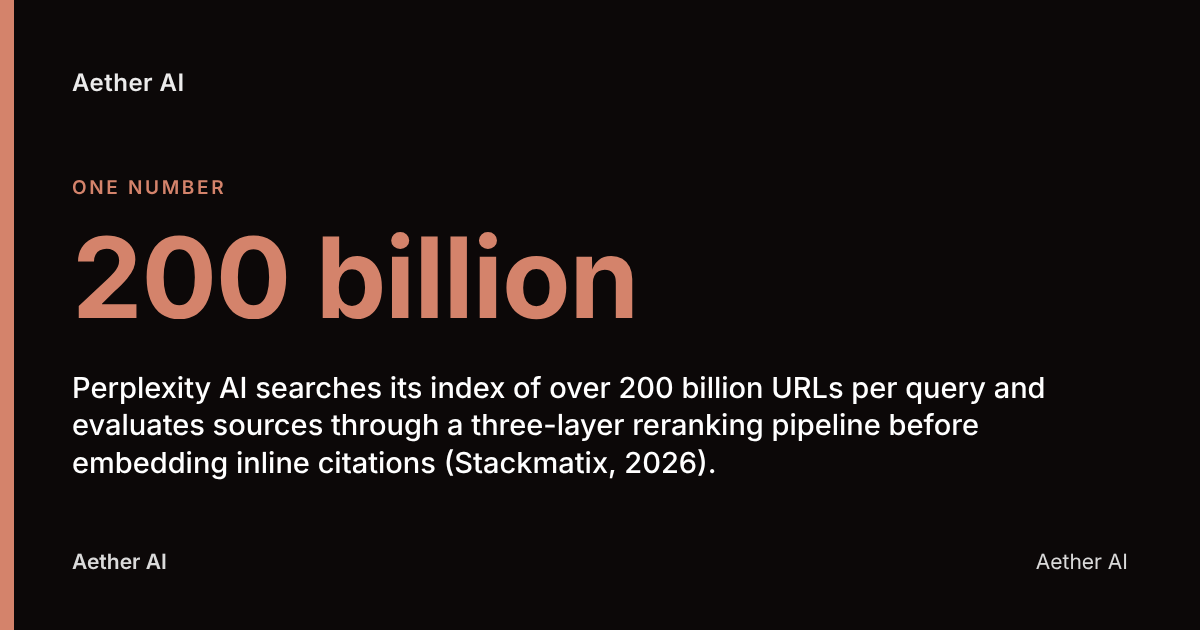
Perplexity searches a huge index of web sources, reranks them for relevance and authority, and attaches numbered inline citations to the specific claims they support rather than generating unsourced text. Perplexity AI searches its index of over 200 billion URLs per query and evaluates sources through a three-layer reranking pipeline before embedding inline citations (Stackmatix, 2026).
Key Takeaways
- Perplexity's citations come from a ranking pipeline. They are not a fact check. Domain authority is only one input, so a cited source can still be outdated or paywalled.
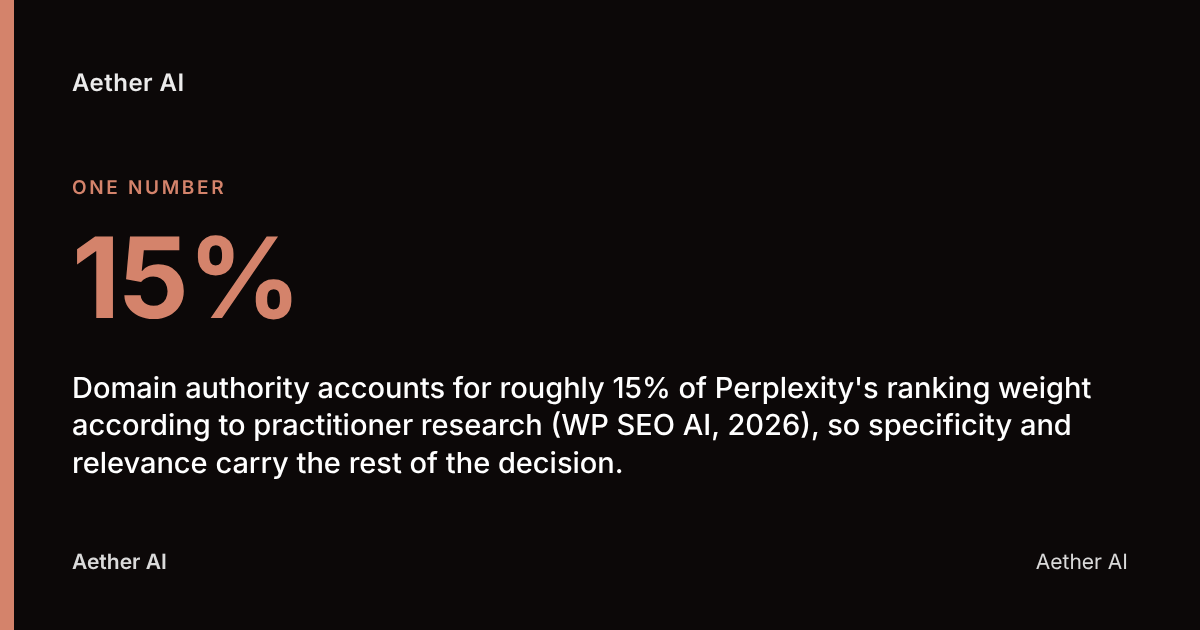
- Domain authority accounts for roughly 15% of Perplexity's ranking weight according to practitioner research (WP SEO AI, 2026), so specificity and relevance carry the rest of the decision.
- A business wanting to appear in Perplexity's answers should check which plan a reader is likely using, since free and Pro Search draw on very different numbers of sources.
What Perplexity AI is and how its answer engine generates cited answers
Perplexity is a search-based answer engine, meaning it retrieves live web pages before it writes a reply, rather than drawing only on information learned during model training. This is why its answers arrive with clickable citations attached to specific sentences, and not as a single list of links at the bottom.
Perplexity's own help centre describes this process: the product interprets a query, searches the web, and generates numbered citations that link straight back to the original source (Perplexity Help Center). That retrieval step happens every time a question is asked, so an answer about a fast-moving topic reflects pages indexed close to that moment. It does not rely on a static knowledge cut-off.
The practical effect for a business is that being cited is not a one-off achievement. A page that earns a citation today can lose it tomorrow if a more specific or more recently updated page appears. Perplexity's own blog on getting started also outlines Focus modes. These let a user narrow retrieval to particular source types such as academic papers or recent news, which changes which pages are eligible to be cited (Perplexity Hub Blog).
How Perplexity generates and ranks citations behind each answer
Citations are produced by a multi-layer reranking pipeline that weighs relevance, specificity and domain authority before a source is linked to a claim. Perplexity does not simply cite whichever page ranks first in a traditional search index; it re-evaluates retrieved pages against the exact wording of the question.
Domain authority is one factor in Perplexity's ranking weight according to practitioner research (WP SEO AI, 2026). That leaves most of the ranking decision to other signals, chiefly how directly a page answers the question and how specific its claims are. WP SEO AI's research describes this in terms of "trust seeds": domains the platform recognises as containing human-verified, authoritative information, which earn more citations as a result.
Lauren Dawkins, Head of Content at Aether AI, puts the practical implication this way:
"Engines cite pages that answer a question completely in one place, say something specific, and come from a source that looks like it should know. Vague pages summarising other pages don't get cited — they get paraphrased without credit. Specificity is the whole game."
That matters because many business websites write general overview pages, hoping to rank for a broad topic. Perplexity's pipeline rewards the opposite: a page that states one fact plainly, attributes it, and answers the question in full within a single passage. A page that only gestures at a topic, without a concrete figure or a direct answer, is more likely to be summarised without credit. It is less likely to be linked as a source.
Perplexity citations versus ChatGPT, Google AI Overviews and Copilot
Perplexity's citation-first design and market position set it apart from rivals that cite less consistently or hold a larger share of the market. The table below compares two things that matter most to a business trying to get cited: how reliably citations appear, and how much of the AI chatbot market each tool reaches.
| Engine | Citation behaviour | Market position |
|---|---|---|
| Perplexity | Citation-first by design; nearly every claim is linked inline | Approximately 6.4% to 8% share of the AI chatbot market, positioning it third behind ChatGPT and Microsoft Copilot (Perplexity AI Magazine, 2026) |
| ChatGPT | Citations appear in some modes (for example browsing) but not all responses | Largest share of the AI chatbot market |
| Google AI Overviews | Citations shown as linked snippets within search results | Built into Google Search, reaching most search users by default |
| Microsoft Copilot | Citations shown but less consistently tied to individual claims | Second-largest share of the AI chatbot market |
As Wellows contributor Tania Jabar puts it, "Perplexity doesn't rank content. It cites it." That distinction is why businesses pursuing visibility in Perplexity need pages built for citation, separate from traditional search ranking.
Free versus Pro: how source depth differs between Perplexity plans
The free tier and Pro Search differ mainly in how many sources are synthesised per answer, which directly affects citation depth and reliability. Without Pro Search, Perplexity synthesizes information from the top 5 web sources only, while Pro Search synthesizes up to 25 sources (Razia Aliani Substack, 2023).
That gap has two consequences for a business. First, a free-tier answer is built from a narrower pool, so a page competing to be cited faces fewer rivals but also less room for nuance in the final answer. Second, a Pro Search answer draws on five times as many sources. This spreads citations more widely, so a single page is less likely to dominate the response even if it ranks well.
Neither tier guarantees accuracy. Both rely on the same reranking pipeline described above; Pro Search simply applies it to a larger candidate pool before selecting which sources to cite.
SEO and visibility stakes of Perplexity citations for UK businesses
Getting cited by Perplexity matters for UK visibility, but measured data shows most brands are named in only a small fraction of relevant AI answers today. Aether AI's own measured AI-visibility baseline covered 700 live AI engine scans of UK brands' target keywords between July and August 2026. It found the brands were named in 23 answers, or 3.3% of scans; the longest-established brand, in security services, was named in 6.3% of its 270 scans (published at aether-ai.co.uk/insights/ai-visibility-baseline-2026).
That baseline fits the wider picture of Perplexity's citation behaviour described above. Citations go to pages that are specific, well attributed and recognised as authoritative. A business with a broad, general website and no page built to answer one question directly is unlikely to be the exception.
This is also where the limit of the whole system shows up. Perplexity's citations reflect what its reranking pipeline judged most relevant at the moment a query was run. They are not an independent fact check of that page's content. A cited source can be outdated, sit behind a paywall the model could not fully read, or subtly misrepresent the claim it is credited with supporting. A business should treat a citation as evidence of relevance and authority signals. It is not proof that the underlying page is correct.
FAQ
Can Perplexity cite sources that don't actually support its stated claim?
Yes. Perplexity's citation is a product of its reranking pipeline matching a source to a query. It is not an independent verification step. A page can be linked as the source for a claim it states only loosely, or in a way the answer has paraphrased beyond its original meaning.
Does using Perplexity Pro guarantee more accurate citations, or just more of them?
Pro Search increases the number of sources synthesised per answer, from the top 5 on the free tier to up to 25. It does not add a separate accuracy check. More sources can mean more balance in an answer, but each individual citation still comes from the same ranking process used on the free tier.
How often should a business re-check whether it is being cited by Perplexity?
There is no fixed schedule from Perplexity itself, but because its index is refreshed continuously and reranking happens at query time, a citation earned once is not permanent. A business tracking its visibility on a question that matters to its market should check at intervals and not assume a result holds indefinitely.
Can I ask Perplexity to only cite specific types of sources, like academic papers or news sites?
A user can narrow retrieval using Perplexity's Focus modes, which target source types such as academic papers, social discussion, video or general web content. This changes which pages are eligible to be cited in that answer. This is a setting the person asking the question controls, not something a business can request on its own page's behalf.
Turning Perplexity's citation logic into a plan
Understanding how Perplexity's reranking pipeline chooses citations is only useful if a business can see whether it is actually appearing in the answers that matter to its market. Aether AI's citation tracking covers six AI engines, including Perplexity, ChatGPT, Google AI Overviews, Claude, Gemini and Copilot, alongside keyword and competitor tracking and Google Search Console integration. A free AI-visibility audit from Aether AI shows where a business currently stands before any further work is commissioned.