Last updated: 27 November 2026
AI citation share is the percentage of times your brand or website is named as a source when a tool like ChatGPT or Google AI Overviews answers a relevant question. It is calculated as citations attributed to your site, divided by all displayed citations for that query, multiplied by 100, a formula introduced by Microsoft in Bing Webmaster Tools' AI Performance report, according to Search Engine Land (2026).
Key Takeaways
- AI citation share is specific to the query set and platform you test, so a single number from one tool tells you less than the same check repeated over time.
- Citation share must be tracked per AI platform, not averaged, because each one draws from a different pool of sources.
- Improving citation share follows a sequence: audit, restructure content, build authority signals, then re-test.
What is AI citation share?
AI citation share measures how often your brand is named or linked as a source in AI-generated answers. It is expressed as a percentage of all citations shown across a set of queries. It is not a single score for your whole brand. It is a figure tied to a particular platform, a particular set of prompts, and a particular moment, because AI answers change as models update and as competing content shifts.
Think of it as a sample, not a certificate. A business might run 50 prompts relevant to its market on one AI engine and find it was cited in 5 of them. That is a citation share for that batch, on that engine, on that day. Run the same prompts a month later and the number can move, sometimes a lot, because the underlying answer generation is not fixed.
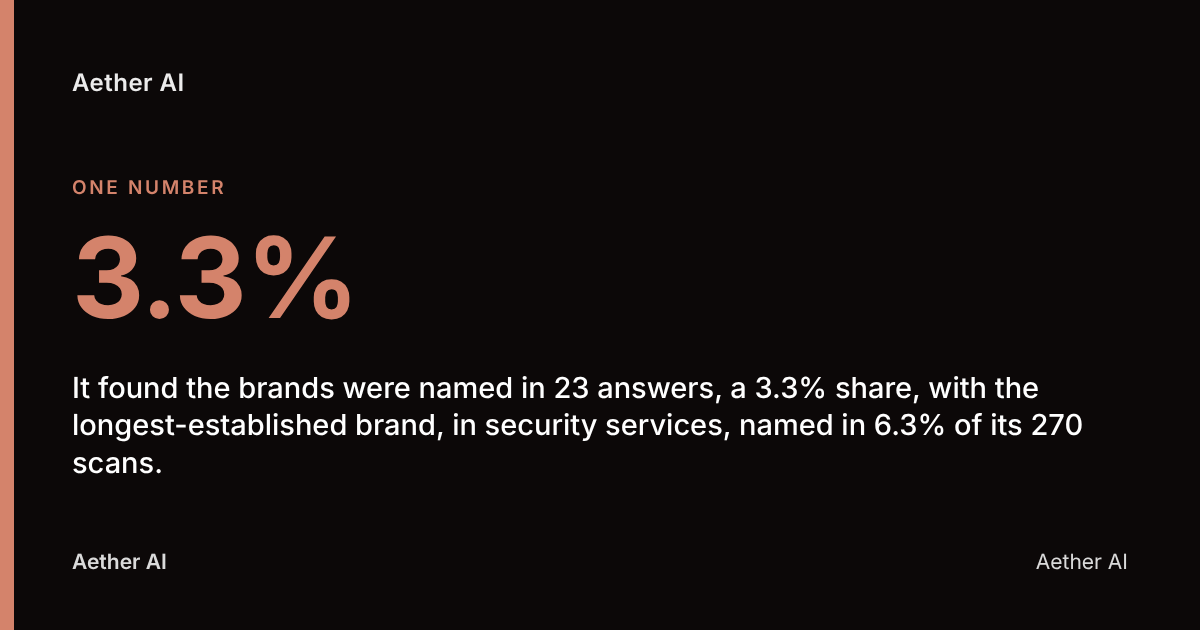
This is why a one-off check is of limited use on its own. Aether AI's measured AI-visibility baseline, published at aether-ai.co.uk/insights/ai-visibility-baseline-2026, ran 700 live AI engine scans of UK brands' target keywords in July and August 2026. It found the brands were named in 23 answers, a 3.3% share, with the longest-established brand, in security services, named in 6.3% of its 270 scans. That spread, between an overall figure and one established brand doing better, is the kind of detail a single-platform snapshot can miss.
How to measure AI citation share and which UK tools track it
UK businesses have three realistic ways to measure citation share: Bing's own report, third-party GEO platforms, or manual prompt testing. (GEO, generative engine optimisation, is the practice of shaping content so AI tools cite it.) Each gives a different balance of coverage, cost and effort.
Bing Webmaster Tools is the only major search platform to officially define and report citation share as a built-in metric. It is free to anyone who verifies their site, per the Bing Webmaster Tools AI Performance Report. It covers Bing's own AI answers and Copilot, but not ChatGPT, Perplexity or Google. Third-party platforms and manual testing fill that gap, at different costs in time or budget.
| Method | Coverage | Cost | Effort |
|---|---|---|---|
| Bing Webmaster Tools | Bing AI answers, Copilot | Free | Low, automated |
| Third-party GEO platforms | Multiple engines (varies by tool) | Paid, varies by provider | Low once set up |
| Manual prompt testing | Whichever engines you choose to test | Free (time cost only) | High, repeated manually |
Scale matters here too. A single-category example from Similarweb shows Sephora achieving a roughly 16% citation share across a 179-prompt beauty category query set on ChatGPT, according to Similarweb (2026). That figure came from a large, controlled prompt set built for one category, which is a different exercise from checking a handful of queries by hand.
Which AI platforms to monitor and how they differ
ChatGPT, Google AI Overviews, Perplexity and Microsoft Copilot pull from different source pools, so citation share has to be tracked per platform. A strong share on one engine does not imply the same on another.
Google AI Overviews, for instance, leans heavily on video. YouTube is the most-cited domain in Google AI Overviews, capturing 24.5% of citations as of November 2026, according to Ahrefs (2026). That is a domain-type bias no single blog post can fully overcome; it says something about how Google's system is built, not about any one brand's content quality.
ChatGPT, Perplexity and Copilot each have their own patterns: some favour recently published pages, some weight forums and review sites more heavily, some cite fewer sources per answer overall. Monitoring all four separately is the only way to know where a brand actually stands; a result on one platform does not carry over to the rest. Aether AI's platform tracks citation share across six AI engines (ChatGPT, Perplexity, Google AI Overviews, Claude, Gemini and Copilot). A brand's position looks different depending which engine is asked.
Practical steps to improve AI citation share
Improving citation share takes several steps, each building on the last. Each step builds on the last.
- Audit current visibility. Run a consistent set of prompts across the platforms that matter to your market and record where you are cited, where competitors are cited, and where no one is.
- Restructure content for extractability. Put the direct answer in the first few sentences of each page, define terms where they first appear, and write each fact as a complete, quotable sentence.
- Build topical authority signals. Cover a subject fully across multiple pages, link them to each other, and keep facts current, since freshness is one factor AI systems weigh.
- Re-test and track changes over time. Repeat the same prompt set on a schedule and compare the results over time.
Lauren Dawkins, Head of Content at Aether AI, puts the content side of this plainly: "Definition first, specifics throughout, one question answered completely per page. Machines skim like ruthless editors: if the answer isn't extractable in the first screen, they take it from someone whose page is. Write for the reader; structure for the machine."
Benchmarks help set expectations for this work. For most B2B SaaS categories, a citation share above 30% indicates strong AI visibility, while below 10% means a brand is effectively invisible in AI answers, and most brands starting their GEO journey are below 5% citation share, according to RankScope (2026). Moving from near-zero to a measurable share is realistic within that range; moving straight to market leadership on every platform is not.
Who should own AI citation share within a UK business
AI citation share works best as a shared responsibility, usually led by the SEO or content team but drawing on others. No single department has everything it needs on its own.
Content and SEO teams own the structural work: page layout, answer placement, and keeping pages current. PR has a role too, because authority signals, the mentions, links, and press coverage that AI systems treat as trust markers, build up outside your own website. Product specialists and subject experts matter for accuracy, since an AI system favours sources that get facts right and penalises pages it later finds out of date.
A single owner tends to leave gaps: content without PR input struggles to build authority, and PR without content input has nothing structured for AI systems to cite. Treating it as one team's sole job is the most common reason progress stalls.
One limit worth stating plainly: citation share from any single tool or scan is a snapshot, no more. As the Microsoft Bing Team notes, "Citation activity can be influenced by many factors including evolving AI models, competing content, freshness signals, and shifts in user demand." The same team is also clear about what the metric is not: "Importantly, Citation Share is designed as an observational metric, not a ranking system or a competitive scoreboard. It does not expose competitor domains, represent traffic share, or assign quality scores to content." Treat each reading as one data point in an ongoing check.
FAQ
Is AI citation share the same as being mentioned by name without a link?
No. Citation share, as Bing defines it, counts citations attributed to your site in displayed sources for a query. This means a link or clear source attribution, not a passing mention of your brand name with no sourcing.
Can a small UK business realistically compete with large sites like Wikipedia or Forbes for citation share?
On broad, generic queries, large reference and media sites often dominate because they cover ground comprehensively. On specific, niche or local queries closer to what your business does, a smaller site with precise answers can be cited where a larger site offers nothing detailed.
Does improving AI citation share also help traditional Google rankings?
The two are not the same measure, but the underlying work overlaps. Clear, well-structured, accurate content that AI systems prefer to cite tends to be the same content that performs well in conventional search rankings.
How often should citation share be re-checked once a baseline is set?
There is no fixed rule, but given that AI answers shift with model updates, competing content and demand, a one-off check tells you less than a repeated one. Checking on a regular schedule is what turns a snapshot into something useful.
Where this leaves a UK business
Knowing your AI citation share, on even one platform, is more than most UK businesses have today. The harder part is tracking it consistently across the platforms your customers actually use, and acting on what the pattern shows. Aether AI's free AI-visibility audit checks where your brand currently stands and tracks citation share across six AI engines from there. Get in touch to run one.