Last updated: 24 November 2026
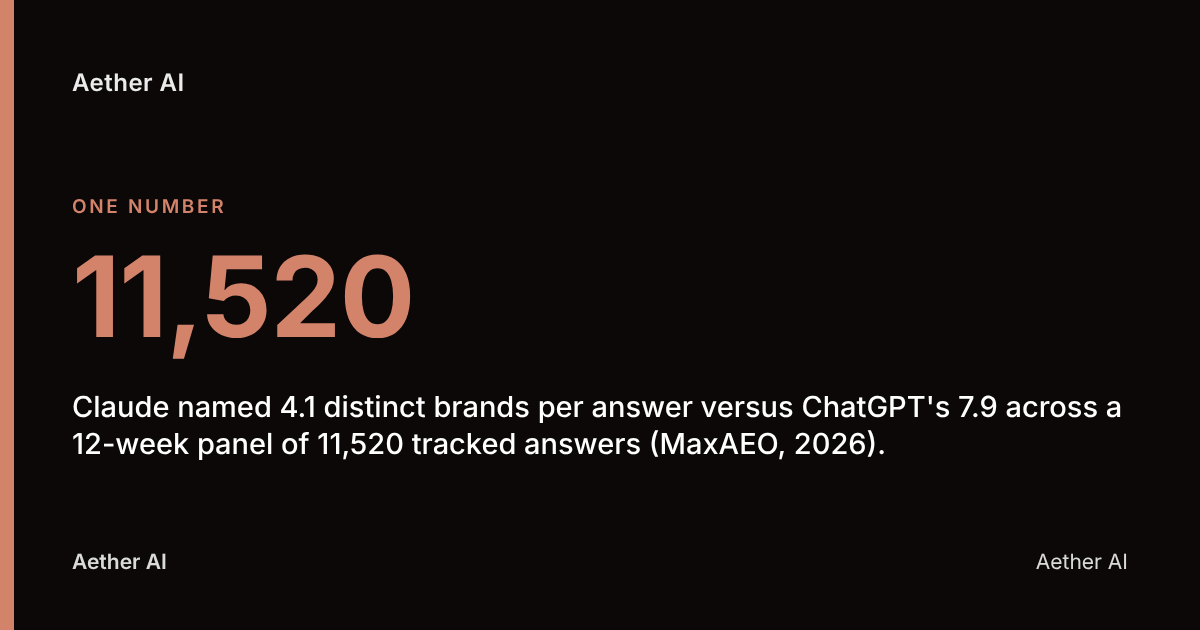
Yes. Claude names fewer brands per answer than ChatGPT, varies its top pick more often across repeated queries, and leaves out more well-known names. Claude named 4.1 distinct brands per answer versus ChatGPT's 7.9 across a 12-week panel of 11,520 tracked answers (MaxAEO, 2026).
Key Takeaways
- Claude applies a narrower filter than ChatGPT, mentioning fewer brands per answer and sometimes no brand at all for buyer-intent prompts.
- Neither assistant is a reliable, repeatable source: the same query asked twice can return different brands, different rankings, or a different top pick entirely.
- Checking visibility properly means testing across several engines and phrasings, not trusting one favourable mention.
Why Claude and ChatGPT recommend different brands for the same query
Claude and ChatGPT are built on different training philosophies, and that difference shows up directly in how many brands each one is willing to name. Claude is trained using Constitutional AI (CAI), a method Anthropic describes in its own account of Claude's Constitution, where the model is guided by a written set of principles rather than purely by human feedback on individual answers. ChatGPT, by contrast, relies more heavily on reinforcement learning from human feedback (RLHF), where human raters score many candidate answers and the model learns to produce what raters preferred.
That distinction matters because it sets a different bar for what counts as a "safe enough" brand to mention. A CAI-trained model is built to weigh harm and uncertainty before answering, which tends to produce more hedged, more cautious output. An RLHF-trained model optimised on rater preference tends to reward answers that feel complete and confident, which favours listing more options.
Neither approach is wrong. They are simply tuned for different outcomes: Claude for caution, ChatGPT for coverage. For a business trying to get named, this means the two assistants are not interchangeable targets. Being well placed in ChatGPT's answers says nothing certain about whether Claude will mention you at all, and the reverse is equally true.
How consistent are brand recommendations across repeated queries and phrasings
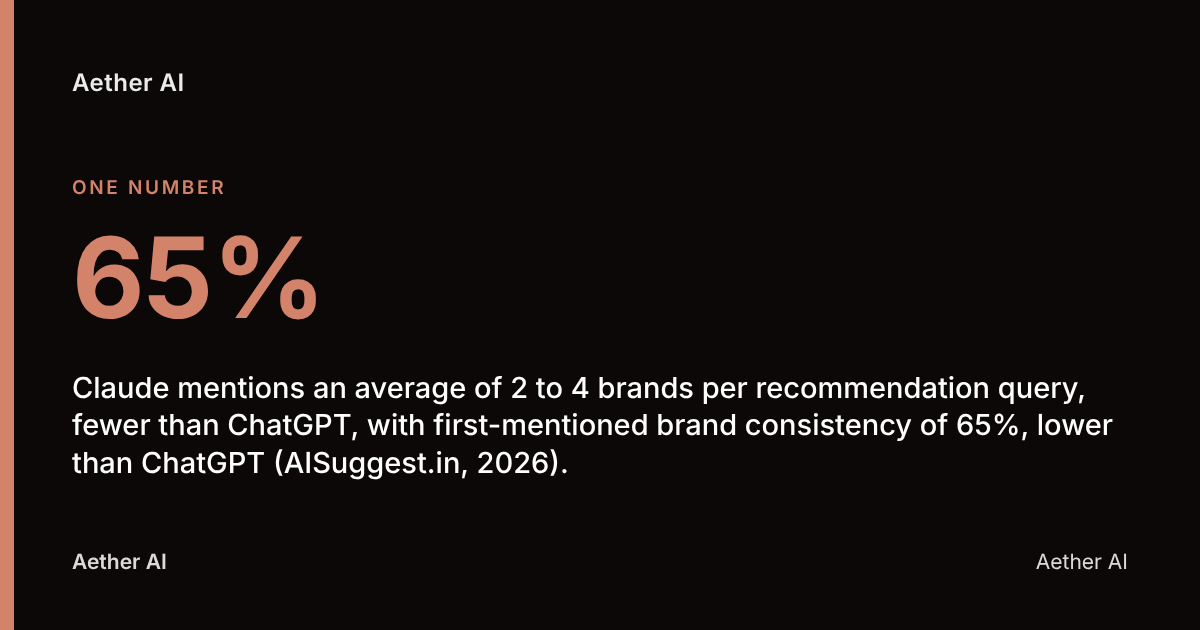
Both assistants are inconsistent when the same question is asked more than once, but Claude's narrower style makes this more visible. Claude mentions an average of 2 to 4 brands per recommendation query, fewer than ChatGPT, with first-mentioned brand consistency of 65%, lower than ChatGPT (AISuggest.in, 2026). The brand Claude names first today may not be the brand it names first tomorrow, even for an identical prompt.
This matters more than it sounds. A single good mention from Claude is not proof of durable visibility; it may simply be what the model generated on that pass. Rand Fishkin, co-founder and CEO of SparkToro, has made this point directly in the primary research behind this field: "These [AI assistants and generative search summaries] are probability engines: they're designed to generate unique answers every time." He goes further: "Thinking of them as sources of truth or consistency is provably nonsensical."
That framing, set out in SparkToro's research on AI inconsistency, should change how a business reads a single screenshot of an AI answer. One mention, however flattering, is a sample of one. The question worth asking is not "did it mention us" but "how often, across how many variations of the question, does it mention us."
Does Claude favour different brands than ChatGPT in the same test set
Yes, and a controlled test shows it clearly. A 1,400-prompt study of 50 B2B SaaS companies found ChatGPT and Gemini mentioned 100% of tested brands while Claude mentioned 88%, with six well-known names absent entirely (MaxAEO, 2026). Every brand in the test set was real, established, and findable by a search engine. Claude still left some out.
This isn't a training data gap; it's a filtering decision baked into how the model is built. Claude's Constitutional AI approach appears to apply a stricter threshold for which brands it's confident enough to recommend, while ChatGPT and Gemini default towards inclusion. For a business, the practical read is that Claude is the harder platform to appear in. It isn't because it knows less, but because it's built to say less when it isn't sure.
This is also why the 23% of Claude's answers that MaxAEO found gave an explicitly ordered ranking matters less than it first appears (MaxAEO). Being in Claude's answer at all is the bigger hurdle. No brand appeared in 9.4% of buyer-intent prompts Claude was tested against, meaning Claude sometimes declines to name anyone at all.
What UK businesses should check before relying on AI brand recommendations
Checking AI visibility properly means running repeated tests, not trusting a single good answer. Most businesses that check find they're named far less often than they expect, across every engine.
- Test the same question across Claude, ChatGPT, Gemini, Perplexity, Google AI Overviews and Copilot.
- Vary the phrasing: "Treat llms.txt like you treated meta keywords: cheap to add, unproven as a lever, no substitute for the fundamentals. What measurably matters is whether AI crawlers can fetch and parse your pages at all — server-rendered content, clean structure, no login walls in front of your best answers." gets different results from "recommend a company that does X".
- Repeat each query several times over a few days before drawing any conclusion from a single answer.
- Check whether a query names you at all before worrying about ranking position; absence is the more common problem.
- Treat a good mention as a data point and recheck it periodically.
A measured baseline of 700 live AI engine scans of UK brands' target keywords, run in July and August 2026, found the brands tested were named in only 23 answers. That's 3.3%. Even the longest-established brand tested, a security services provider, was named in only 6.3% of its 270 scans. That baseline is one Aether AI recorded itself, and it matches the wider pattern. Across engines, most brands are barely named at all, a more urgent problem than which assistant favours which brand.
Common mistakes UK businesses make trying to get recommended by AI assistants
The two most common errors are blocking AI crawlers outright and chasing clicks instead of aiming to be the named answer. Both come from applying old search logic to a system that doesn't work the same way.
Blocking GPTBot and similar crawlers feels like protecting content, but it usually does the opposite. Lauren Dawkins, Head of Content at Aether AI, puts it plainly: "Blocking GPTBot to protect your content is like delisting from Google to protect your brochure. Defensible for a paywalled publisher; self-harm for anyone who sells something. If assistants can't read you, they recommend whoever they can read."
The second mistake is measuring success by clicks alone. A large share of search traffic never shows up in standard reporting. On two properties connected to Aether AI's founding team, Priority First and Aether Agency, 82% and 88% of Google Search Console clicks between 19 July and 15 August 2026 came from queries Google doesn't name in its reports. Google withholds rare and low-volume queries to protect searchers' privacy. Aether AI is built and operated by Aether Agency Ltd. Priority First, Pulse Operations and Aether Agency are businesses connected to the founding team. Lauren Dawkins adds: "The click was always a proxy. What matters is being the name the buyer carries into the conversation. AI referrals are smaller in volume and radically better in intent, the person who arrives from an assistant has already been told you're the answer."
It's worth being honest about the limits here too. It's worth being honest about the limits here too. These findings come from a 12-week panel and a prompt-based snapshot. Both Claude and ChatGPT update their models regularly, so exact percentages will drift over time even if the pattern holds.
FAQ
Can a business pay to be featured in Claude or ChatGPT's answers?
No. Neither Anthropic nor OpenAI currently sells placement in Claude or ChatGPT's answers. Visibility comes from how clearly and credibly a business's own content answers the question being asked.
Why did Claude mention my competitor but not my brand?
It may be because your competitor's content is clearer, more current, or simply easier for Claude to find and verify. It could also just be the variability inherent to the model: the same query run again might produce a different result.
Does Claude use the internet to check current information, or only its training data?
Claude can access current web information in some contexts, but its core behaviour still reflects the training approach, Constitutional AI, described in Anthropic's own account of Claude's Constitution. That shapes which sources it trusts and how cautiously it responds, separate from whether it can technically browse.
Who is liable if an AI assistant recommends a brand that turns out to be unreliable?
This is an evolving area without settled UK case law specific to AI brand recommendations. Businesses should not treat an AI assistant's mention as an endorsement or guarantee, and should apply their own due diligence regardless of how a brand was discovered.
Checking where you actually stand
Knowing that Claude and ChatGPT behave differently is only useful if you know where your own brand sits on each one. Aether AI's citation tracking checks visibility across six AI engines, including Claude, ChatGPT, Perplexity, Google AI Overviews, Gemini and Copilot. Start with the free AI-visibility audit to see how your brand currently appears across these engines.