Last updated: 27 November 2026
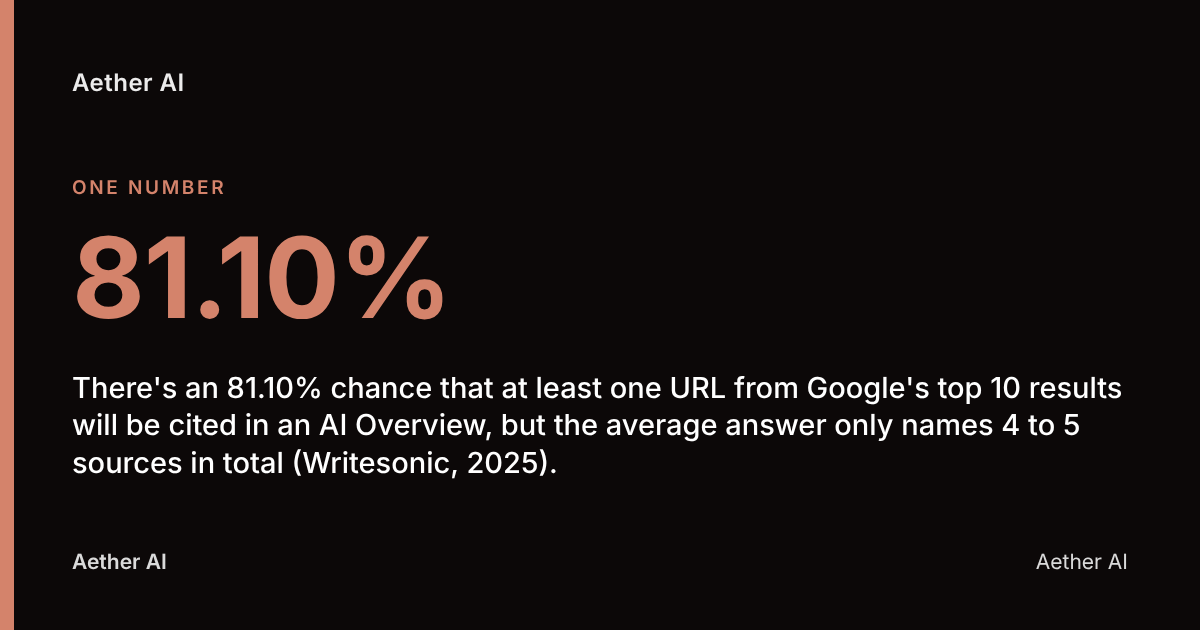
Google AI citation analysis means checking which URLs Google's AI Overviews or Gemini reference when answering a query, then tracking whether your own site appears. There's an 81.10% chance that at least one URL from Google's top 10 results will be cited in an AI Overview, but the average answer only names 4 to 5 sources in total (Writesonic, 2025).
Key Takeaways
- Citation in an AI Overview is not the same as ranking well: most cited pages are not in the organic top 10, so a strong ranking position alone will not tell you whether Google's AI mentions you.
- Checking Google Search Console for traffic from queries Google will not name you is one of the few free signals a business can use to spot AI-driven visits.
- Treat any citation count as a snapshot. It is not a trend. Google's AI answers change often, and a page cited today may not be cited next week.
What is Google AI citation analysis?
Google AI citation analysis identifies and tracks which sources Google's AI systems reference or link to inside a generated answer. It does not track where a page ranks in the traditional blue links. It treats an AI Overview, or an answer inside Google's AI Mode, as its own kind of result, worth measuring on its own terms.
Citation and ranking are not the same measurement. A page can sit at position one on a search results page and still be left out of the AI Overview above it. The reverse also happens: a page outside the top 10 can be the one Google's AI quotes. AI Overviews include around 4 to 5 citations on average, with a maximum of 33 (Writesonic, 2025). That is a narrow shortlist. Only a handful of pages make the cut for most queries. A business needs a way to find out whether theirs is one of them, query by query, rather than assuming a good ranking carries across automatically.
The same fundamentals of clear, well-structured, useful content apply, but the shortlist is tighter and the selection logic is less visible than a standard ranking.
How Google AI decides which sources to cite
Google's AI systems favour passages that answer a question directly and clearly, often pulled from pages that never reach the organic top 10. Only about 17% of sources cited in AI Overviews also rank in the organic top 10, meaning roughly 5 out of 6 AI Overview citations pull from content that never appeared on page one of traditional results (BrightEdge, 2025/2026).
That overlap figure is the clearest evidence that AI citation and organic ranking are separate games, worth tracking separately. Google's own properties are also heavily represented: over 43% of AI Overview responses contain links to Google.com, making it the most commonly cited domain (SE Ranking, 2025). That includes Google's own products, such as Maps, Shopping and YouTube, competing for the same citation slots as independent websites.
Google has described the system as "built to only show information that is backed up by top web results", while also acknowledging it can "sometimes produce unhelpful or inaccurate results", according to Google's own statements. For a business, the practical reading is this: being well-established or well-ranked helps, but it does not guarantee a citation, and the system is openly imperfect. Further detail on how AI Overviews select and cite content is in Google's own documentation, Google Search Central: AI Features and Your Website, and in independent passage-level analysis from CXL.
How a UK business can check if Google's AI is citing its content
A business can check this with three complementary methods: running the queries itself, reading Search Console data, and using a dedicated tracking tool.
- Run the target queries manually. Search the phrases a customer would use, note whether an AI Overview appears, and record which domains it cites. Repeat weekly, since answers shift.
- Review Google Search Console for unnamed query traffic. Google withholds rare and low-volume queries from its reports to protect searcher privacy. A rising share of clicks from queries Google will not name can be one signal of AI-driven referral traffic, though it is not proof on its own.
- Use a dedicated AI citation tracking tool that scans multiple AI engines against a set of target keywords rather than relying on spot checks.
Expectations matter here. Aether AI's own measurement, based on 700 live AI engine scans of UK brands' target keywords in July and August 2026, found those brands named in 23 answers, or 3.3%. The longest-established brand in that set, a security services provider, was named in 6.3% of its 270 scans. That is consistent with how narrow the citation shortlist is industry-wide: even a well-established brand was named in a small minority of its scans. A business starting this work should expect low citation rates as the baseline.
Google AI citation analysis vs traditional backlink analysis vs rank trackers
These three measurements answer different questions, and a business needs all three, not one in place of the others.
| Method | What it measures | What it cannot tell you |
|---|---|---|
| Backlink analysis | Who links to your site, and how that changes over time | Whether an AI answer names you at all |
| Rank tracking | Your position for a given search query | Whether you are cited inside an AI Overview above that result |
| AI citation tracking | Whether, and how often, an AI answer names your site | Why Google's AI chose one source over another |
Backlink tools and rank trackers are mature, well-understood categories. AI citation tracking is newer and measures a different outcome: not where you sit on a results page, but whether an AI-generated answer mentions you by name or link. A business relying only on rank tracking has no way to know its AI Overview citation rate, since, as the overlap figure above shows, the two very often diverge.
How to improve your chances of being cited by Google AI
No method guarantees a citation, but certain practices are documented as improving the odds.
- Answer the question directly, early in the page. Pages that state a clear answer near the top are more likely to supply the exact passage an AI system quotes.
- Structure content so a single passage stands alone. Short, self-contained sentences that name their own subject are easier to lift into a generated answer.
- Back claims with named, checkable sources. Google's AI leans on information "backed up by top web results", so citing real data and crediting it clearly supports that selection logic.
- Keep content current. Pages updated to reflect the latest figures and guidance are more likely to remain eligible as the underlying search results shift.
None of this is a guarantee. Citation tracking tools and manual query checks only sample a moment in time. Google's AI answers change often, citation rates are low even for established brands, and no tool, including this one, can promise inclusion.
FAQ
Does being cited by Google AI guarantee more website traffic?
No. A citation can appear as a link a user never clicks, since many AI Overview answers satisfy the question on the results page itself. Citation is a visibility signal worth tracking. It is not a guaranteed traffic outcome.
Can small UK businesses realistically compete for AI citations against larger sites?
Yes, in principle, because a top-10 ranking is not a prerequisite for being cited. A smaller site with a direct, well-structured answer can be cited ahead of a larger competitor that ranks higher but answers less clearly.
Is there a cost to tracking AI citations, or can it be done for free?
Manual query checks and Google Search Console review cost nothing but time. Dedicated tracking tools that monitor multiple AI engines against a full keyword set carry a cost depending on the scale needed. A quote confirms it for any specific tool.
Who should own AI citation monitoring within a marketing team?
Whoever currently owns organic search performance is best placed to add this, since it draws on the same Search Console data and query research already used for SEO. It works best as an addition to that role.
Where this fits next
Checking manually and reading Search Console reports will tell a business roughly where it stands. Doing that consistently across ChatGPT, Perplexity, Google AI Overviews, Claude, Gemini and Copilot takes a standing process, a one-off check is not enough. Aether AI's citation tracking covers all six of those engines alongside keyword and competitor tracking and Google Search Console integration. The same account shows both AI citation activity and the organic search data it sits beside. A free AI-visibility audit is available for a business that wants a starting picture before deciding whether to track further.