Last updated: 26 November 2026
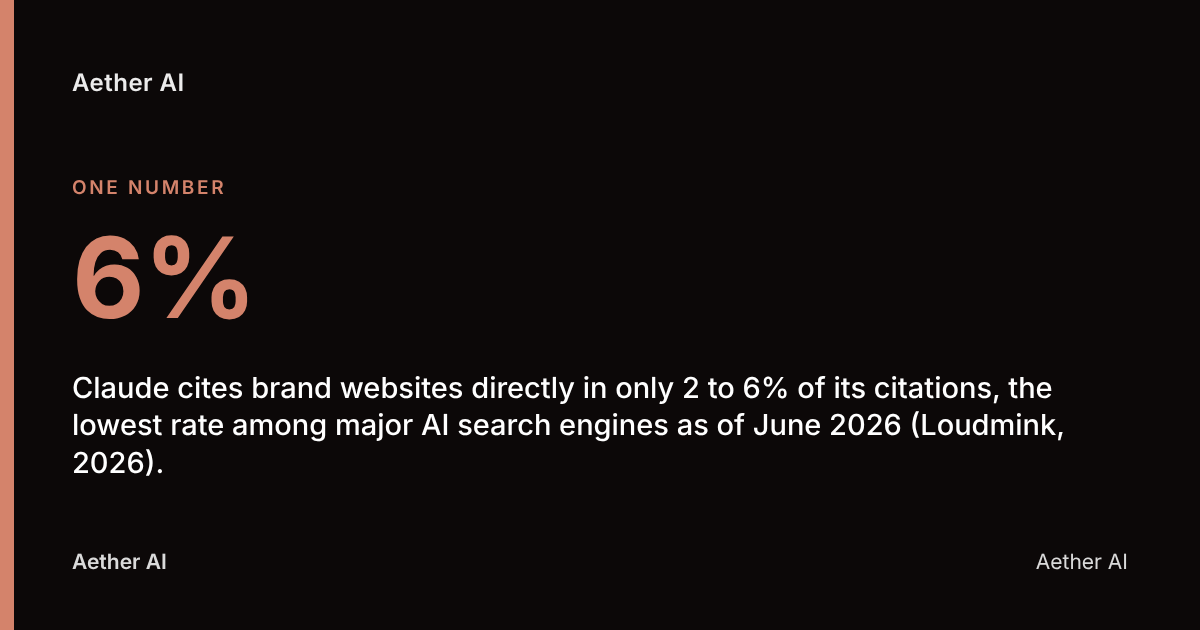
Claude AI search mostly works by running a live web search, commonly reported to use Brave Search as its backend. It then summarises whichever pages rank well there and cites a handful of them. It rarely cites brand websites directly. Claude cites brand websites directly in only 2 to 6% of its citations, the lowest rate among major AI search engines as of June 2026 (Loudmink, 2026).
Key Takeaways
- Claude's business mentions are driven mainly by how well a page performs in its backend search results. There is no separate business directory Anthropic maintains.
- Claude favours third-party and review-style content over brand-owned websites, so a strong homepage alone is unlikely to secure a mention.
- Claude sometimes answers business questions from training data alone, without searching the web or citing any source at all.
What Claude AI search is and how it differs from Google search results
Claude AI search is a web search tool built into Anthropic's Claude. It issues a query to a backend search engine, retrieves a set of results, and writes an answer that cites a small number of sources. Anthropic's own documentation describes the tool as returning search queries, results and citation blocks with source URLs and quoted text. The reader gets a synthesised answer rather than a list of links (Anthropic Claude API Documentation , Web Search Tool).
Google, by contrast, returns a ranked list of pages and leaves the clicking and comparing to the user. Claude does that comparing itself, then presents a conclusion with a few supporting links attached. Anthropic has said there is no toggle to turn this on and off: as Anthropic puts it in its Help Center, "there's no web search toggle. Claude searches the web when it helps."
That difference matters for a business. Being ranked somewhere in Google's results is no longer the end goal. Being one of the few sources Claude chooses to cite is the new bar. Reporting from TechCrunch and independent testing both point to Brave Search as the likely engine behind Claude's web search, based on Anthropic's own subprocessor disclosures (TechCrunch).
Ranking signals Claude uses when selecting which businesses to mention
Claude's business selection is largely inherited from its backend search engine's own rankings. Anthropic has not built a separate scoring system for businesses. Independent testing found that Claude's citations matched Brave's top results roughly 86.7% of the time (RivalHound, 2026).
That figure is the clearest evidence available that normal search visibility is still the strongest proxy signal for being picked by Claude. If a page ranks well on Brave for a relevant query, it stands a far better chance of being pulled into Claude's answer and cited. Developer Simon Willison's independent analysis reached a similar conclusion after comparing Claude's citations directly against Brave Search results for the same queries (Simon Willison).
This means there is no separate "Claude SEO" trick that bypasses conventional search visibility. A business that has invested in being found, ranked and trusted in ordinary search results is already doing most of what matters for Claude. Chasing Claude specifically, while ignoring underlying search performance, is unlikely to work on its own. Claude's citation choices are downstream of a search ranking it did not invent.
Where Claude pulls business information from: websites, directories and review sites
Claude cites brand-owned websites only rarely, leaning instead on aggregator pages, directories, review platforms and editorial roundups that already compare several businesses. In a study of 25 brand queries, Claude mentioned the most brands of any AI search engine tested, 22 of the 25. Yet it had the lowest brand-website citation rate of the group (Loudmink, 2026).
Put those two facts together and the picture is clear: Claude talks about plenty of brands, but it rarely sends the credit, or the click, to the brand's own site. It would rather quote a third-party page that already names several options.
This is consistent with a wider pattern Aether AI has measured directly. In 700 live AI engine scans of UK brands' target keywords run in July and August 2026, the brands were named in only 23 answers, 3.3% of scans. Even the longest-established brand in the group, a security services firm, was named in just 6.3% of its 270 scans. That baseline, published at aether-ai.co.uk/insights/ai-visibility-baseline-2026, shows how rarely any single business gets picked, whichever AI engine is doing the picking. It lines up with Claude's habit of spreading citations across third-party sources rather than a brand's own pages.
The upshot for anyone running a business is that a polished homepage is necessary but not sufficient. If the directory, review and comparison pages in your sector do not mention you, Claude has little reason to find you either.
Does Claude always search the web, and how fresh is its business information
No, Claude does not always search the web before answering a business question. Anthropic confirms that Claude decides for itself when a search will help, which means some answers come entirely from its training data, with no citation attached at all.
In a test of 20 German business questions, Claude answered 10 of them without searching the web at all, and cited no sources for those answers (itgrows.ai, 2025). That is a meaningful limit on any optimisation strategy: if Claude answers from memory, nothing on a live web page, however well it ranks, can influence that particular answer.
Anthropic describes the web search feature itself in plain terms: "When Claude incorporates information from the web into its responses, it provides direct citations so you can easily fact check sources." That is reassuring when a search happens. It says nothing about the roughly half of cases, in the German test, where no search happened at all.
The practical consequence is that a business's details can be stale, outdated or simply absent from a Claude answer, even when that business is well represented online elsewhere. There is no reliable way to force a search to happen for a given query.
Practical steps to improve your chances of being picked by Claude AI search
The most effective lever is strengthening presence on the third-party sites Claude actually cites, not optimising the brand website in isolation. That means working through the sources Claude's backend search engine already favours.
Check standard search visibility first. Since Claude's citations closely track its backend search engine's own rankings, ordinary search performance (clear page titles, accurate business information, decent page speed) remains the foundation.
Get listed and reviewed on the directories and comparison sites your sector actually uses. Claude leans on aggregator and review content, so a page that already compares several businesses in your field is a route worth securing.
Seek coverage on editorial and roundup-style content. A "best of" or comparison article that names your business, even briefly, is the kind of third-party source Claude tends to cite.
Keep core business facts (name, location, services, pricing basics) consistent everywhere they appear. Inconsistent details across sites make it harder for any search engine, or for Claude's summarising step, to settle confidently on the right answer.
Re-check regularly; do not treat any of this as fixed. Claude's selection behaviour is inferred from third-party testing, not disclosed by Anthropic, and its backend search provider and citation patterns can change without notice. An approach that works today may need adjusting in six months.
FAQ
Can I ask Claude directly whether it recommends my business?
Yes, but treat the answer with caution. Asking Claude a live question shows one response at one moment, not a stable pattern. Claude's answers vary by query phrasing and by whether it chooses to search the web at all.
Does Claude use the same information for every user, or does it personalise results?
Claude's web search runs fresh for each query. It does not draw on a personal profile of the user, based on how Anthropic describes the tool. The results can still vary between sessions because the underlying search and Claude's decision to search at all are not fixed.
Will optimising for Google also help with Claude AI search?
Largely, yes, because Claude's citations closely mirror its backend search engine's own top results, and general search visibility is the strongest available proxy signal. It is not a guarantee, since Claude also weighs third-party directories and review content more heavily than brand websites, and sometimes skips web search altogether.
Is there a way to submit or verify my business listing directly with Anthropic?
No public submission or verification process for business listings is documented by Anthropic. Claude draws on its backend web search and its training data. There is no business directory that owners can register with.
Getting a clearer picture of where you stand
Claude's selection behaviour is not published by Anthropic and is inferred from third-party testing, which means it can shift without notice as Anthropic adjusts its search backend or citation rules. Treat any approach here as something to re-check periodically.
Aether AI tracks citations across six AI engines, including Claude, ChatGPT, Perplexity, Google AI Overviews, Gemini and Copilot, alongside keyword and competitor tracking and Google Search Console integration. A free AI-visibility audit from Aether AI shows where your business currently stands across those engines, which is the starting point before deciding what to fix.