Last updated: 26 November 2026
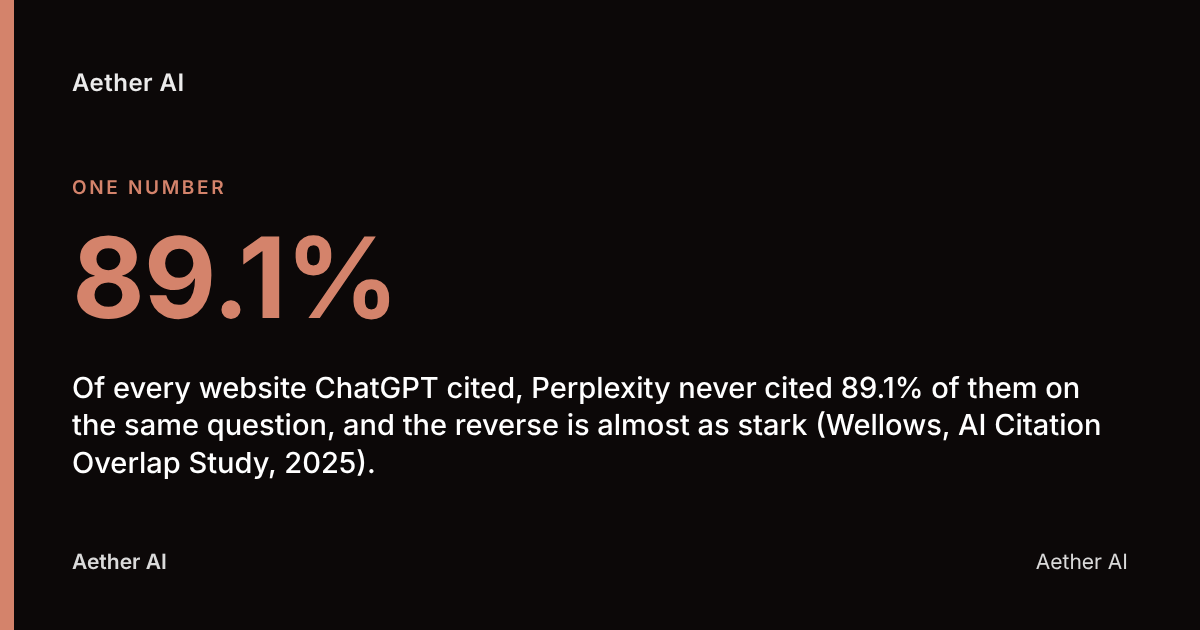
Perplexity citation gap analysis compares which sources Perplexity cites for your target queries against which of those are your pages. Then it fixes why yours are missing. It matters because Perplexity's citation behaviour is distinct enough that a gap found there won't show up in a ChatGPT or Google audit. Of every website ChatGPT cited, Perplexity never cited 89.1% of them on the same question, and the reverse is almost as stark (Wellows, AI Citation Overlap Study, 2025).
Key Takeaways
- A Perplexity gap can exist even when a page ranks well on Google and gets mentioned by ChatGPT, because Perplexity draws from a largely different pool of sources.
- Closing the gap means finding the exact competitor pages Perplexity keeps citing in place of yours, not chasing a general visibility score.
- Citation presence shifts as Perplexity re-crawls and re-ranks the web, so one audit only captures a single moment.
What is perplexity citation gap analysis?
Perplexity citation gap analysis is a repeatable audit that compares, query by query, which domains Perplexity cites against which of those citations belong to you. It identifies specific missing or weak pages: the exact answer a competitor gave that yours didn't, for the exact question a buyer is likely to ask.
The method works because Perplexity's answers are heavily sourced. It cites an average of 21.87 citations per question, 2.76 times more sources than ChatGPT's 7.92 (Qwairy, Perplexity vs ChatGPT: AI Citation Study (Q3 2025), 2025). That volume means a single answer often draws from twenty or more domains, which gives an auditor plenty to compare against.
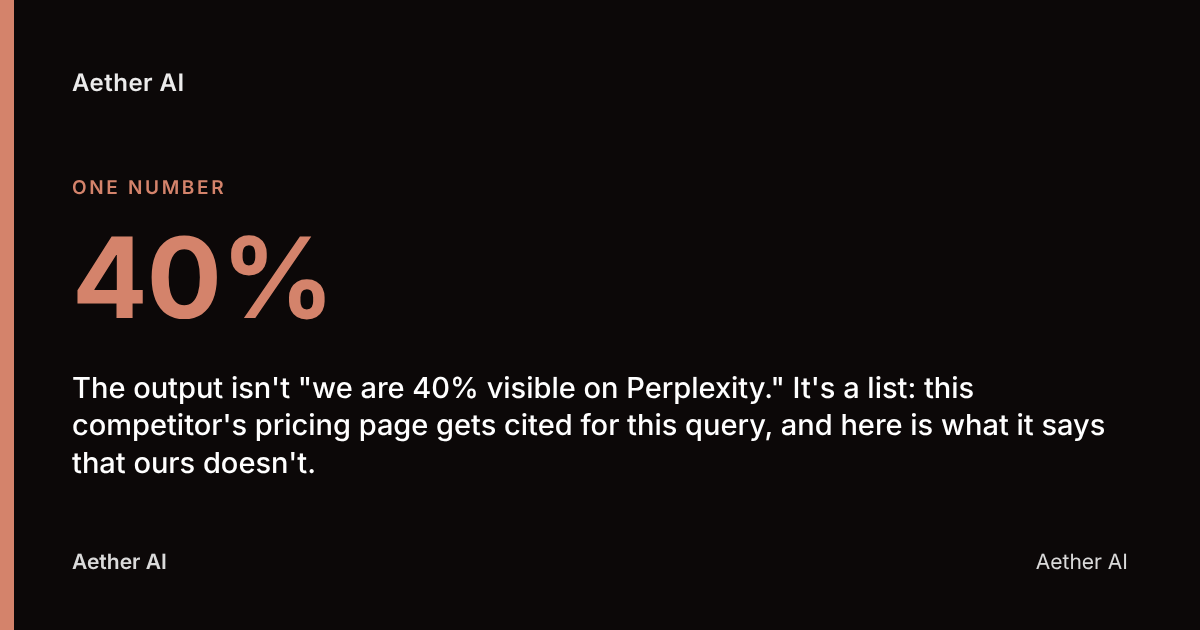
A proper gap analysis runs the same query set repeatedly, because Perplexity's citations aren't fixed: the same question asked a week apart can pull a different mix of sources. The output isn't "we are 40% visible on Perplexity." It's a list: this competitor's pricing page gets cited for this query, and here is what it says that ours doesn't. That specificity is what makes the gap closeable.
Why Perplexity matters separately from Google and ChatGPT for UK businesses
Perplexity matters as its own audit because its citation pool and its source preferences differ sharply from ChatGPT's and from Google's organic results. A business that has optimised only for Google rankings, or secured a mention from ChatGPT, can still be entirely absent from Perplexity's answers on the same topic.
The clearest evidence is the brand citation gap between the two engines. Perplexity's brand citation rate is 13.05% versus ChatGPT's 0.59%, a 22 times gap (Everything-PR, Perplexity Citation Source Index 2026, 2026). Perplexity also leans on a different kind of source entirely. Reddit accounts for 46.7% of its top 10 cited sources, more than three times its next most-cited source, YouTube at 13.9% (Profound, AI Platform Citation Patterns, 2025).
Brand websites and traditional media matter less here than forums and video, so a page built purely for SEO can be invisible to Perplexity even while it performs well elsewhere. Aether AI's own baseline, drawn from 700 live AI engine scans of UK brands' target keywords across July and August 2026, found those brands were named in just 23 answers, or 3.3% (published at aether-ai.co.uk/insights/ai-visibility-baseline-2026). That low a rate is consistent with how narrow and source-specific each engine's citation habits are.
Finding competitor citations you're missing on Perplexity
Finding the gap means logging, question by question, which domains Perplexity names and comparing that list against your own pages. The process is manual but mechanical, and it produces a working list.
- Build a query list of 15 to 30 questions a buyer would realistically ask, phrased the way they'd type or say them, no keyword fragments.
- Run each query through Perplexity on a schedule, such as weekly, and record every cited domain, including those beyond the first answer shown.
- Mark which citations are yours, which are direct competitors', and which are third parties such as review sites, forums or trade press.
- Flag any query where a competitor is cited and you aren't, then open that competitor's page to see what it answers that yours doesn't.
- Repeat the same query set over several weeks before drawing conclusions, since a single run can be skewed by a recent re-crawl.
The output of this process is a short list of specific, fixable gaps: particular pages, on particular topics, that a competitor currently owns in Perplexity's answers. That's a more useful instruction for a content team than a general instruction to "improve AI visibility."
In-house audit vs agency-led citation analysis
The real choice is between running this manually with free tools and paying for a monitored, ongoing service. The right answer depends on how many queries matter and how often they need checking. Both are legitimate; they suit different situations.
| In-house manual audit | Agency-led or platform-led analysis | |
|---|---|---|
| Cost | Free, but takes staff time every week | A cost depends on the job and the number of queries tracked; ask for a quote |
| Speed | Slow to scale past a handful of queries | Built to track many queries and competitors continuously |
| Consistency | Easy to miss a week or change methodology by accident | Runs on a fixed schedule, so results are comparable over time |
| Best suited to | A small number of core queries, checked occasionally | Ongoing monitoring across many queries, engines and competitors |
A business with five core queries and a spare afternoon a month can run this in-house indefinitely. A business tracking dozens of queries across multiple engines, where a missed citation means a missed sale, generally needs something built to run continuously, not checked by hand.
Content and technical changes that improve Perplexity citation odds
Pages get cited when they answer one specific question completely, state a precise fact early, and come from a source that reads as authoritative on that exact topic. Vague or general pages tend to get summarised without credit, rarely cited directly.
Lauren Dawkins, Head of Content at Aether AI, puts it this way: "Engines cite pages that answer a question completely in one place, say something specific, and come from a source that looks like it should know. Vague pages summarising other pages don't get cited — they get paraphrased without credit. Specificity is the whole game."
In practice, that means naming the real number, the real regulator, the real standard, rather than hedging with "it depends" when a concrete answer exists. Put the direct answer in the first two or three sentences of a section. An engine skimming for an extractable answer takes the clearest one it finds, often before paragraph six. It also means writing for one question at a time, not one long page trying to cover ten.
Technical structure helps too: clear headings that match how people actually ask the question, dates on data so an engine can judge how current it is, and links to primary sources. None of this guarantees a citation on any single question, since Perplexity's source mix shifts week to week as it re-crawls and re-ranks the web. That's the honest limit: gap analysis and the fixes that follow it need repeating on a schedule, not treated as a one-off project.
FAQ
Can I track Perplexity citations automatically instead of checking manually?
Yes, in principle, though the method described above works with nothing more than manual queries and a spreadsheet. Tools built for this track citations across multiple engines on a schedule, without someone having to run and log each query by hand.
Does getting cited by Perplexity actually drive measurable traffic?
Citations can drive clicks, but a lot of the actual search demand behind them doesn't show up cleanly in standard analytics. On two properties connected to Aether AI's founding team, Priority First and Aether Agency, 82.1% and 88.3% of Google Search Console clicks between 19 July and 15 August 2026 came from queries Google doesn't name in its reports. Google withholds rare and low-volume searches to protect searchers' privacy. Aether AI is built and operated by Aether Agency Ltd. Priority First, Pulse Operations and Aether Agency are businesses connected to the founding team. That pattern suggests a large share of real search and citation activity is simply not visible in the reports most businesses check.
Will the same content changes help with ChatGPT or Google's AI Overviews too?
Specific, well-sourced, clearly structured content tends to help across engines generally, but the overlap in who actually gets cited is low. ChatGPT never cites 90.1% of the sources Perplexity cites for the same questions (Wellows, AI Citation Overlap Study, 2025), so treat each engine's citation list as its own target.
How many queries should I audit before drawing conclusions about a citation gap?
There's no fixed number in the research, but a handful of queries checked once isn't enough, because citations shift as Perplexity re-crawls sources. A wider query set, checked repeatedly over several weeks, gives a more reliable picture than a single pass over a small list.
Closing the gap
A citation gap on Perplexity is specific and fixable once it's been found, but finding it by hand across dozens of queries and several engines takes real time every week. Aether AI's citation tracking covers six AI engines, including Perplexity, Google AI Overviews, ChatGPT, Claude, Gemini and Copilot, alongside keyword and competitor tracking and a free AI-visibility audit. If you want to see where your pages stand against competitors' right now, get in touch to run that audit.