Last updated: 24 November 2026
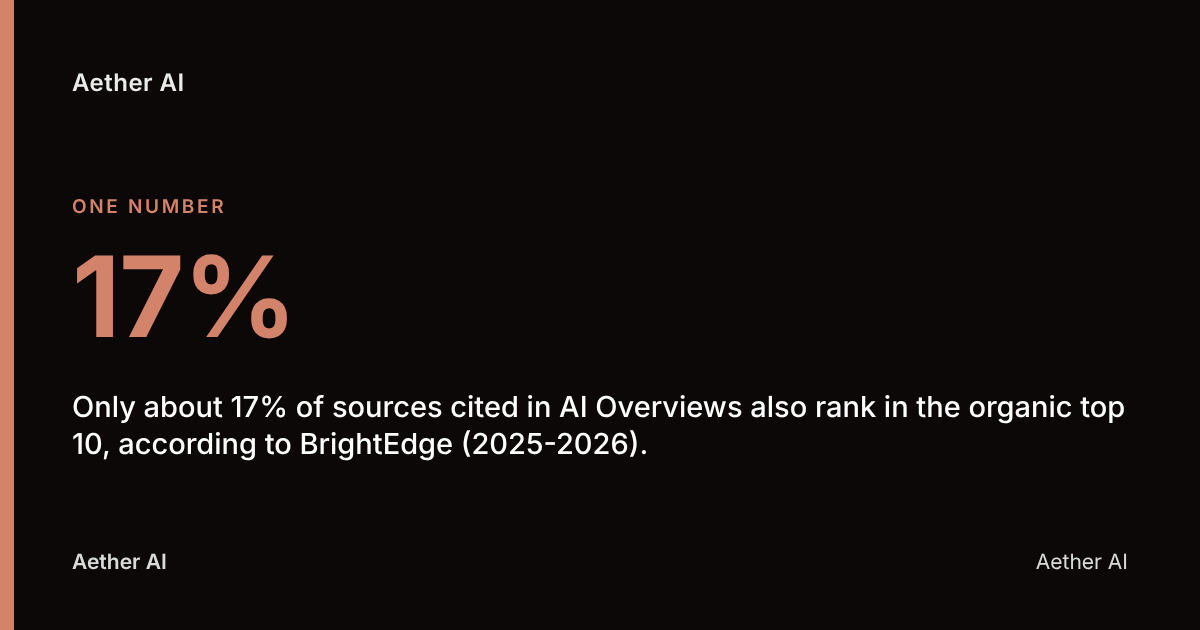
You can see who gets cited in AI Overviews by combining Google Search Console's AI performance filters with manual SERP checks and third-party tracking tools. But remember: citation overlaps with normal rankings far less than most people assume. Only about 17% of sources cited in AI Overviews also rank in the organic top 10, according to BrightEdge (2025-2026).
Key Takeaways
- Checking citations needs more than a rankings report: Google Search Console's AI performance filters, manual spot-checks and third-party tools each show a different slice of the picture.
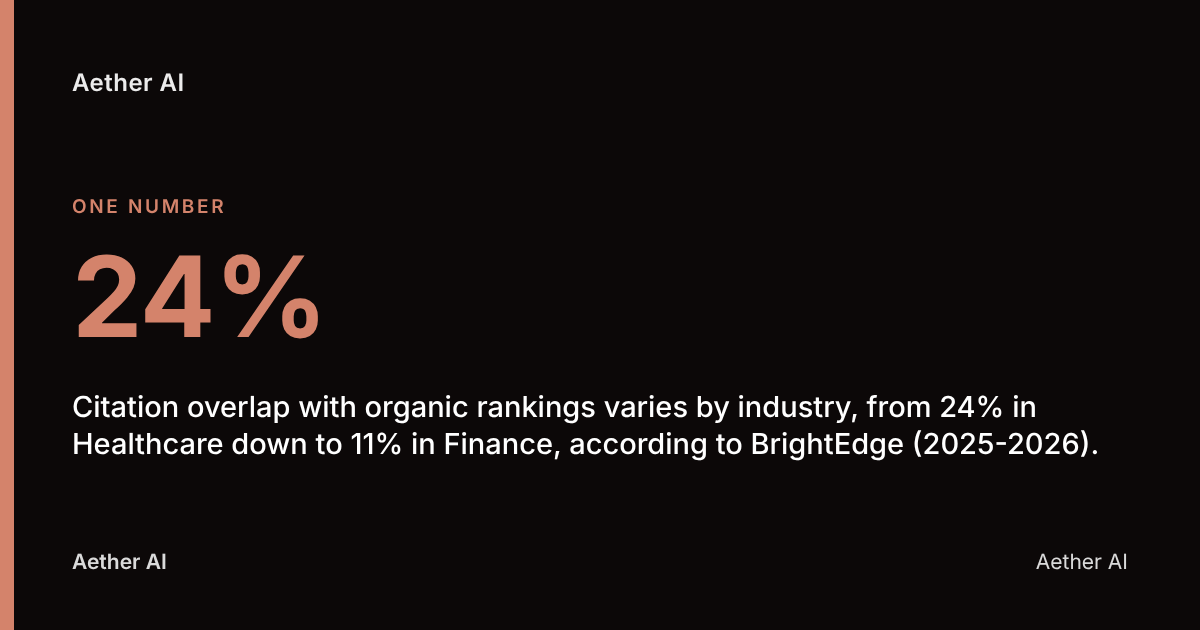
- Citation overlap with organic rankings varies by industry, from 24% in Healthcare down to 11% in Finance, according to BrightEdge (2025-2026).
- Treat any third-party citation tool's numbers as directional, not exact, because none of them log every AI answer that exists.
What Google AI Overviews are and how they differ from standard results
AI Overviews are Google's generated answers that sit above standard organic results, built by pulling and synthesising information from several sources at once. A reader sees one blended answer, not ten separate links to click through. A reader sees one blended answer and does not need to click through ten blue links.
About 30% of keywords trigger AI Overviews in US SERPs (search engine results pages), according to SE Ranking (2025). The same research found that answer length and citation count move together. Shorter responses, under 600 characters, cite 5.31 sources on average, while responses over 6,600 characters cite 28 sources, according to SE Ranking (2025).
That matters for how you check citations. A short, direct AI Overview answer has far fewer slots available than a long, detailed one covering a complex question. If your target keyword tends to produce short answers, there is less room for your page to appear at all, no matter how well it ranks elsewhere.
Tools and methods for checking if your website is cited in AI Overviews
The starting point is Google Search Console, which now reports impressions for pages appearing inside AI Overviews and AI Mode. It breaks this down by page, country, device and date, through its Generative AI Performance Report. This is the only official, first-party view into citation activity that Google itself provides.
Beyond that single official source, checking citation status is mostly manual or paid. A practical sequence:
- Filter Google Search Console's performance report for AI-related surfaces and look for pages generating impressions without matching click-through data, a sign they are being shown inside an AI Overview and not a standard listing.
- Search your target keywords manually, in an incognito browser, and record which domains appear inside the generated answer as well as the organic list below it.
- Repeat the manual check across devices and locations, since AI Overviews can vary by query phrasing and by session.
- Use a paid tracking tool, such as those offered by Surfer SEO or SE Ranking, to automate citation checks at a scale manual searching cannot match.
- Cross-reference tool output against your own manual spot-checks before trusting any single number.
No single method gives a complete picture on its own. Google Search Console shows impressions but not always which exact citation triggered them. Manual checks are accurate for the moment you run them but do not scale. Paid tools scale but sample rather than log every query, so treat their figures as estimates.
Checking which competitors are cited in AI Overviews for your keywords
Manually running your target queries and logging which domains get cited reveals patterns in what Google currently trusts for that topic. Do this for the 10 to 20 keywords that matter most to your business, and track the cited domains over several weeks.
Look for what the cited pages have in common: Do they share a content format, such as a defined-term opening sentence or a numbered list? Are they from an established publisher, a government source, or a niche specialist? Competitor citation patterns often tell you more than general best-practice advice. They are specific to your exact topic and search intent.
This exercise also exposes a harder truth. If none of your direct competitors are cited either, the opportunity may be open. But it may also mean the query format favours a type of source, such as a reference site or forum, that none of you can easily become. Recognising that early saves time spent chasing a citation that structure alone will not win.
Why AI Overview citations differ from ranking in traditional search results
Citation and ranking are two separate scoreboards, and the overlap between them is low. A page can rank first in Google's standard results and still be left out of the AI Overview entirely. The systems selecting citations weigh different signals than classic ranking factors.
| Traditional ranking | AI Overview citation |
|---|---|
| Measured by position (1 to 10) on the results page | Measured by inclusion or exclusion in a generated answer |
| Based on established ranking factors like backlinks and relevance | Based on how well content can be extracted and synthesised |
| One page, one position | Multiple sources blended into a single answer |
| Overlap with AI citation: only about 17% of cited sources also rank in the organic top 10 (BrightEdge, 2025-2026) | Overlap varies by sector: 24% in Healthcare, 11% in Finance (BrightEdge, 2025-2026) |
The gap is widest in sectors like Finance, where Google appears to lean on a narrower, more established set of sources regardless of standard ranking position. This means a page ranking well is no guarantee of a citation. A page with a modest ranking can still be cited if its structure and authority fit what the system is drawing from.
What determines whether a page gets cited, and a realistic baseline to expect
Citation favours pages that are already established, structurally clear and backed by domain authority, which is why a small group of giant platforms dominate most citations. Based on analysis of over 36 million AI Overviews and 46 million citations between March and August 2025, Wikipedia, YouTube, Google's own properties, Reddit and Amazon collectively account for 38% of all AI Overview citations, according to The Digital Bloom (2025). That leaves the remaining citations spread across every other domain on the web.
Against that backdrop, most individual brands should expect low single-digit citation rates, not frequent mentions. A measured AI-visibility baseline, published at aether-ai.co.uk/insights/ai-visibility-baseline-2026, ran 700 live AI engine scans of UK brands' target keywords in July and August 2026. The brands were named in 23 answers, or 3.3%, and the longest-established brand, in security services, was named in 6.3% of its 270 scans. That is consistent with the wider picture: citation is concentrated among a handful of dominant sources, and most brands, even established ones, are cited rarely.
"SEO earns you a ranking; GEO earns you a mention in the answer itself. The overlap is real — clean structure, genuine authority — but the scoreboard changed. Position three on Google still gets seen. Being absent from an AI answer means you simply don't exist for that buyer," said Lauren Dawkins, Head of Content, Aether AI
A real limit here: third-party AI citation tracking tools work by sampling queries. They do not log every answer Google generates. Different tools will report different citation rates for the same keyword set, because they sample differently. Treat any figure from these tools as directional, a trend to watch, and not an exact count to report as fact.
FAQ
How much does it cost to monitor AI Overview citations with third-party SEO tools?
Cost depends on the tool, the number of keywords tracked and the scale of your site. There is no fixed industry price for this, so get a quote from the provider that fits your needs before committing.
How often do AI Overview citations change, and how frequently should I check them?
AI Overview citations can change as Google updates its models and as source pages themselves update, so checking weekly for your core keywords is a reasonable baseline. High-value or competitive keywords are worth checking more often, since citation status there tends to shift faster.
What common mistakes do businesses make when tracking or optimising for AI Overview citations?
The most common mistake is assuming a high organic ranking guarantees a citation. Citation overlaps with normal rankings far less than most people assume, according to BrightEdge (2025-2026). A second is trusting a single tracking tool's numbers as exact, rather than cross-checking with manual searches.
How do I measure the business impact of being cited versus not cited in an AI Overview?
Start with Google Search Console's AI performance data to see impressions linked to AI surfaces, then compare traffic and enquiries from those keywords before and after a citation appears. Citations are inconsistent and can disappear as quickly as they appear, so measure over several weeks before drawing conclusions from a single snapshot.
Turning citation checks into a citation strategy
Checking who gets cited tells you where you stand. Acting on it is a separate job: restructuring content, building the authority signals AI systems draw on, and tracking whether changes move the needle across engines, including beyond Google. Aether AI offers citation tracking across six AI engines, including ChatGPT, Perplexity, Google AI Overviews, Claude, Gemini and Copilot, alongside a free AI-visibility audit to show where you currently stand. Get in touch to see what that looks like for your business.