Last updated: 21 November 2026
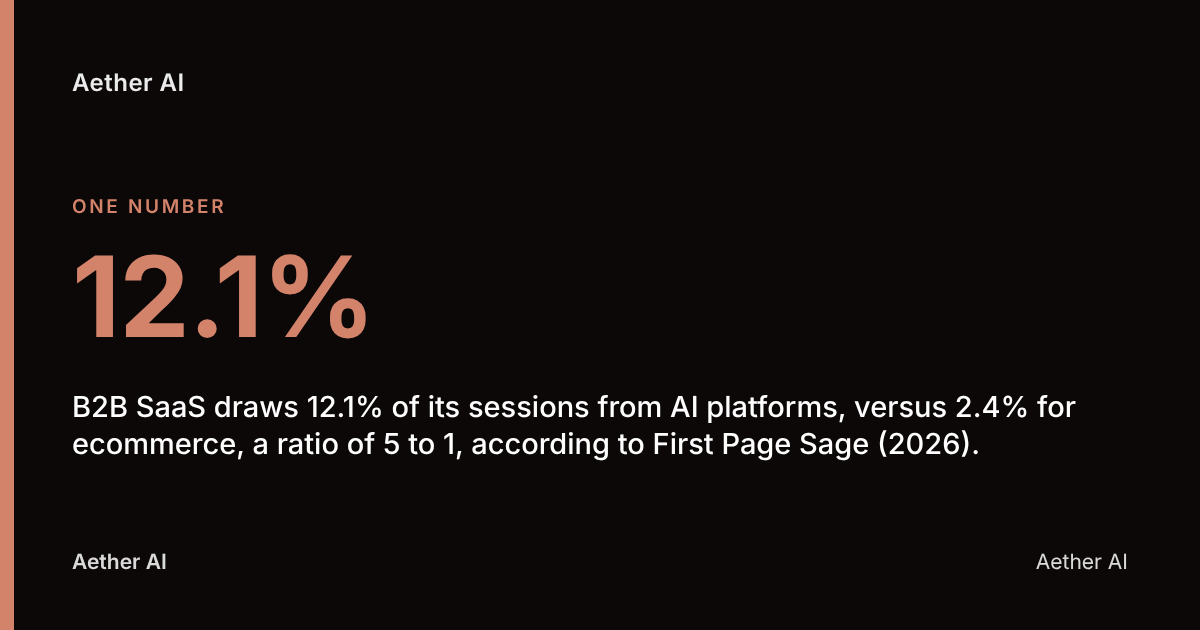
B2B SaaS, healthcare and professional services benefit most from generative engine optimisation (GEO) in the UK, because their buyers research heavily before contacting anyone. B2B SaaS draws 12.1% of its sessions from AI platforms, versus 2.4% for ecommerce, a ratio of 5 to 1, according to First Page Sage (2026).
Key Takeaways
- B2B SaaS receives a far higher share of sessions from AI platforms than ecommerce and retail, according to First Page Sage (2026), because software buyers research more before buying.
- Healthcare citations in AI answers cluster around a small number of trusted domains, which rewards established authority over newly published content.
- A business should audit its current AI-answer visibility before committing budget, rather than assuming GEO will work the same way it does for a competitor in a different sector.
What Does GEO Mean, and How Does It Differ from SEO?
Generative engine optimisation (GEO) is the practice of structuring content so that AI answer engines, such as ChatGPT, Perplexity, Google AI Overviews, Claude, Gemini and Microsoft Copilot, cite a business directly in their generated responses. Traditional search engine optimisation (SEO) aims to rank a web page on a results list a person then clicks through. GEO aims to get a brand's facts, figures and phrasing lifted into the AI's own answer, often with no click at all.
The distinction matters because the two disciplines reward different things. SEO rewards keyword matching, backlinks and page speed. GEO rewards clear definitions, citable statistics, named entities and content structured so a retrieval system can lift a single passage without losing its meaning. Research from arXiv (2023), the paper that coined the term GEO, found that adding citations, quotations and statistics to content can lift source visibility in generative engine responses by up to 40% on the GEO-BENCH research benchmark. That single finding explains most of GEO practice: engines prefer content that already looks like a citable source.
Which Industries See the Biggest GEO Visibility Gains, and Why?
Healthcare, B2B technology and education currently show the strongest AI citation coverage of any sector tracked. Healthcare, B2B Technology, covering SaaS and cybersecurity, and Education currently show strong AI Overview query coverage rates.
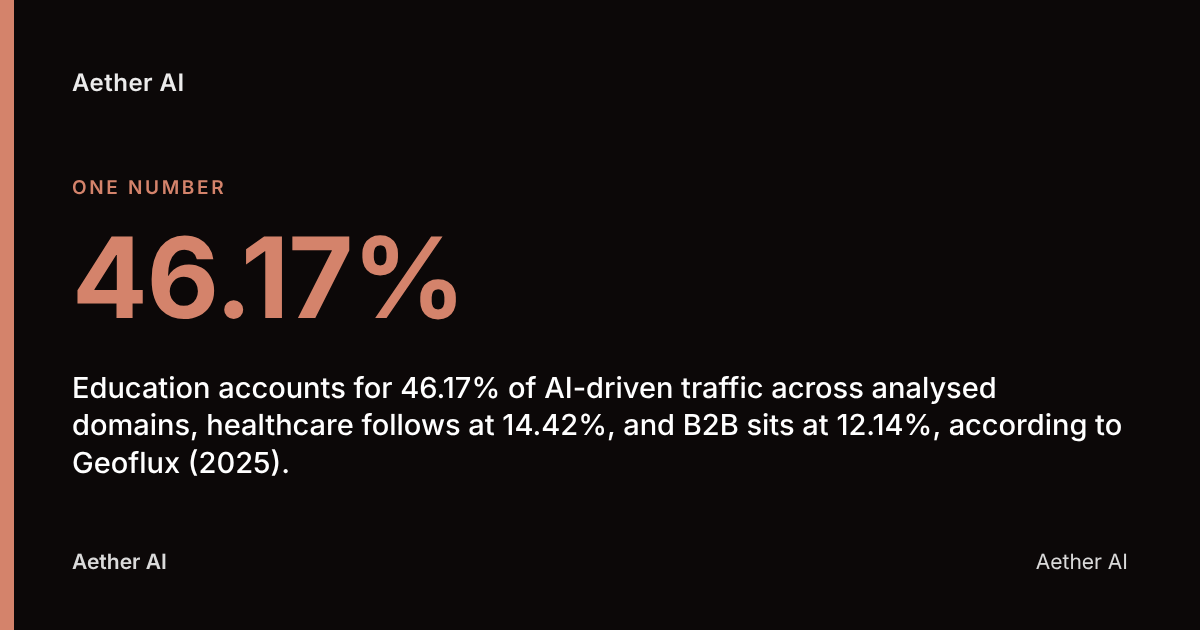
A separate traffic-share study tells a similar story from a different angle. Education accounts for 46.17% of AI-driven traffic across analysed domains, healthcare follows at 14.42%, and B2B sits at 12.14%, according to Geoflux (2025).
Why these three sectors specifically. Healthcare, B2B technology and education all share one trait: buyers and patients ask complex, multi-part questions before they commit to anything. A person researching a diagnosis, a software platform or a qualification wants a synthesised answer, not ten blue links. Manufacturing, Professional Services and SaaS together accounted for roughly 35% of generative AI traffic in 2025, according to WebFX (2025), which also found SaaS and Retail AI referrals converting at more than 50%, against 20 to 30% for organic search.
What Makes an Industry Well Suited to GEO?
An industry benefits from GEO when its buyers ask research-heavy questions with no single obvious answer. Three characteristics predict whether a sector gains most from AI visibility:
- Long, considered buying cycles. Legal services, accountancy, cybersecurity and enterprise software all involve weeks or months of research before a decision, giving GEO content more chances to be cited.
- Complex or regulated subject matter. Healthcare, financial services and legal sectors attract detailed questions that AI engines try to answer with authoritative sources, rather than a single retailer's product page.
- A recognisable base of trusted domains. Healthcare citations concentrate heavily around a small set of established sources, with six domains capturing roughly 71% of all citation slots, according to AI Growth Agent (2025). An industry with few trusted authorities rewards the first movers who establish themselves as one.
Sectors with low research intensity, such as impulse-purchase retail or fast fashion, see far less AI referral activity. A shopper buying an inexpensive t-shirt rarely asks an AI engine to compare twelve brands first.
How Does GEO Benefit B2B Professional Services?
Law firms, accountancy practices and consultancies benefit from GEO because their clients ask AI engines detailed, high-stakes questions before instructing anyone. A business owner searching for guidance on, say, the Companies Act 2006 or a VAT threshold change wants a clear, well-sourced answer, not a list of firm names.
This is where the long research cycle common to professional services does the most work. Legal and accountancy enquiries routinely span regulatory detail, such as Solicitors Regulation Authority (SRA) rules or Financial Conduct Authority (FCA) guidance, and a firm that publishes clear, well-cited explanations of these rules is more likely to be the source an AI engine quotes. Professional services sat alongside Manufacturing and SaaS within the combined share of generative AI traffic reported by WebFX (2025).
"A keyword is what someone types into a search box; a prompt is what they actually want, in a full sentence. Tracking prompts forces you to confront the real question set in your market, and most brands discover the questions they answer well are not the ones being asked," said Lauren Dawkins, Head of Content, Aether AI
That observation matters most for professional services, where the gap between what a firm writes about and what clients actually ask an AI engine tends to be widest.
GEO for E-commerce Compared with Service Businesses
E-commerce and retail receive markedly less AI referral traffic than B2B software or services, because most retail purchases need less research. Ecommerce and retail draw a markedly smaller share of sessions from AI platforms than B2B SaaS receives, according to First Page Sage (2026).
| Sector | AI platform session share / traffic share | Source |
|---|---|---|
| B2B SaaS | 12.1% of sessions from AI platforms | First Page Sage (2026) |
| Ecommerce and retail | 2.4% of sessions from AI platforms | First Page Sage (2026) |
| Healthcare | 88% AI Overview query coverage | Omnibound (2026) |
| B2B Technology (SaaS/cybersecurity) | 82% AI Overview query coverage | Omnibound (2026) |
| Education | 83% AI Overview query coverage; 46.17% of AI-driven traffic | Omnibound (2026); Geoflux (2025) |
Ecommerce benefits in conversion quality over traffic volume. SaaS and Retail AI referrals converted at a notably higher rate than organic search, according to WebFX (2025). A retailer getting fewer AI-driven visits may still find the ones it gets convert at a notably higher rate than its ordinary organic traffic.
Common Mistakes Industries Make When Starting GEO
Most businesses make the same handful of errors when they first try GEO, regardless of sector. Treating it as a rewrite of existing SEO content, as opposed to a distinct discipline, is the most frequent mistake. Content written purely to rank on Google often buries the clear, standalone definitions and figures that AI engines need to lift a passage cleanly.
Other common errors include:
- Publishing content without named sources, dates or standards, leaving nothing concrete for an engine to cite.
- Ignoring prompt-level research, so a firm writes about topics clients never actually ask an AI engine about.
- Assuming one article fixes visibility permanently, when citation tracking across engines like ChatGPT, Perplexity and Google AI Overviews needs to run continuously.
- Skipping an audit of current AI visibility before spending on new content, meaning no one knows whether a gap actually exists.
Aether AI has published 281 articles across the UK brands it writes and publishes for, in security, facilities, software and branding, in the last 30 days, and the platform's own baseline work shows how uneven early AI visibility typically is. In a measured scan of 700 live AI engine queries against those brands' target keywords in July and August 2026, the brands were named in just 23 answers, 3.3%, while the longest-established brand, a security services business, was named in 6.3% of its 270 scans. That gap between a newer brand and an established one mirrors the pattern described above at industry level: trust and history concentrate citations.
FAQ
Is GEO worth it for a small business, or only large enterprises?
GEO suits any business whose buyers research before contacting them, regardless of size. A sole-practice accountant answering regulatory questions clearly can be cited by an AI engine just as readily as a large firm, provided the content is specific, dated and well-sourced.
How long does it take to see results from GEO?
Timelines vary by how established a brand already is and how competitive its sector is for citations. Newer brands tend to be named in far fewer AI answers than a long-established one in the same portfolio, suggesting visibility builds over months, not days.
Who should run GEO inside a UK business: marketing, IT or an agency?
Most GEO work sits naturally with whoever already owns content and SEO, typically a marketing lead or in-house SEO specialist, because the skills (research, writing, citation tracking) overlap heavily with existing SEO duties. IT teams usually only get involved for technical implementation, such as structured data or crawler access.
What should a business check before investing in GEO?
Run an audit of current AI visibility first: search the brand's core topics across ChatGPT, Perplexity, Google AI Overviews, Claude, Gemini and Copilot, and note whether it's named, how often, and which competitors appear instead. Without that baseline, it's impossible to measure whether any GEO investment is actually working.
Where Aether AI Fits for Industries Weighing Up GEO
Deciding whether a sector is a good fit for GEO starts with seeing where a business already stands in AI answers, which is exactly what Aether AI's free AI-visibility audit at /audit is built to show. The platform then tracks citations across six AI engines, ChatGPT, Perplexity, Google AI Overviews, Claude, Gemini and Copilot, alongside keyword and competitor tracking and Google Search Console integration, so a business can see movement over time.
Aether AI is built and operated by Aether Agency Ltd. Priority First, Pulse Operations and Aether Agency are businesses connected to the founding team. On two of those connected properties, Priority First and Aether Agency, Google Search Console clicks from queries Google does not name reached 82.1% and 88.3% respectively between 19 July and 15 August 2026. Google leaves rare and low-volume queries out of these reports to protect searchers' privacy.
Any business unsure whether its industry is a strong GEO candidate can start with the free audit and see its current AI citation rate before committing to anything further. Full pricing is published at /pricing.